The Miami Smart Ring That Caught Marc Andreessen’s Attention

 Spotify
 Apple Podcasts
 YouTube
 RSS Feed
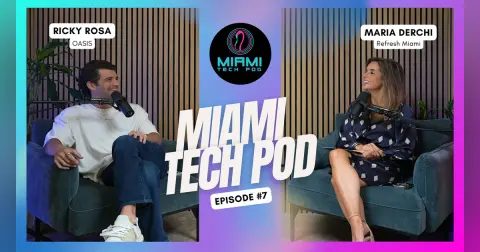
 In this episode of the Miami Tech Pod, Maria sits down with Ricky Rosa, founder of Miami-based Oasis, the startup building what it believes is the next computer interface. Ricky shares how years of work led to a product that caught the attention of Marc Andreessen, generated millions of views worldwide, and is rethinking how we interact with AI.
In this episode, you'll learn:
- Why Oasis says it's not building a smart ring — it's building the next computer interface
- The long-term vision for AI, voice, and what comes after the keyboard
- How Marc Andreessen became one of Oasis' earliest customers
- The launch strategy that generated 2.6 million views and unexpectedly took off in Japan
- Why Ricky ignored investor pressure to add health tracking and stayed laser-focused on one problem
- Why he believes the next generation of great startups will be built in hardware, not software
- Why "greatness requires solitude" and how building from Weston helped him tune out the noise
00:00 - Welcome And What Oasis Is
01:44 - Why A Ring Beats Arm Gestures
05:26 - Whisper Dictation With Touch Editing
07:21 - Raising Money In Unexpected Places
11:32 - Magnetic Charging And Product Focus
17:12 - Patents And Tiny Hardware Constraints
18:09 - How The Launch Hit Millions
25:35 - Solo Founder Choices And Team
29:53 - Climbing Wall Story And Hiring
32:23 - Rapid Fire And How To Buy
Welcome And What Oasis Is
Maria
Welcome to the Miami Tech Pod. I'm your host, Maria Derchi. And as always, we're recording from our home at the lab Miami in Wynwood. Big shout out to the lab for always being such gracious hosts. Today on the pod, we have Ricky Rosa, founder of Oasis. Ricky, welcome to the pod.
Ricky
Thank you for having me.
Maria
I'm really excited for this conversation because I was looking back. When we first met back in 2023, I think we bonded over our love of rock climbing, which maybe we'll get into later in the pod. And that's when you kind of originally told me what you're working on at Oasis. And so I want to kind of get into what Oasis is. It's a smart ring that wants to replace your computer's keyboard, correct?
Ricky
At the beginning, correct. Yes.
Maria
Yes. So I believe you've said you're not building a smart ring, you're building the next computer interface.
Ricky
That's what we're interested in. So we're taking baby steps to get there.
Maria
Okay. So for people who are not aware of what Oasis is, uh, tell us a little bit more.
Ricky
So Oasis is a smart ring for interactions, not for health. So we really want to make clear the distinction that we are not a health ring, at least not at the moment. Uh we're really focused on what the next platform of computing is going to look like for the next 30 years. And we we we noticed that you cannot ask people to take that much novelty at a time. So you have to uh give them a way to move one step from current, and that's it. And so the way that we're doing that at the moment is by letting them have keyboardless experiences with their laptops without having to touch the uh their computer.
Why A Ring Beats Arm Gestures
Maria
And so what made you want to tackle this problem? So especially three years ago.
Ricky
Yeah, actually it goes way longer than that. So the story goes, I was doing blockchain for MasterCard back in 2018, and that didn't really work out for them. It was like back when they were like, oh, we don't do crypto, we do enterprise blockchain. It didn't really work out. But I started hanging around their Media Lab because I was uh in the RD team, and I got to play with the Microsoft HoloLens, the first Microsoft headset. And you could see that this thing was gonna be the future. Uh, you know, now lo and behold, you have to suck and Apple and Snap kind of competing for real estate in your head. But the way that you control these things was very cumbersome. Your arms got very tired. So it's like even back then, 2017, 2018, you could see that there's gonna be this problem for for interactions in the future. So I started thinking about thinking about how we could interface with computers in a more discrete and low energy way. I usually go back to uh optimizing ATP per virtual action. So ATP is the energy molecule of the body. And so basically people are lazy, is what it means. And so, you know, uh back in 2020, I think, was when the first prototypes uh were built uh in in our uh office in in Weston. And we were really trying to think around, you know, how we would control headsets and glasses and all these things, but obviously glasses are just not yet ready to be adopted by the public. I think we're at least five years away. And so the company is literally gonna die. Like if we waited around for glasses to be adopted, for then people need, you know, to need rings to control the glasses, it's like it's just too much. This is like it was never gonna happen. So fortunately, last year we met the Whisperflow guys, and they obviously figured out something about voice that nobody else had at the moment. And we started looking seriously at what problems they were having, and it turns out that you know, voice is three to four times faster than typing. I think Whisperflow proved that already. But you can't use voice in every situation, like you know, when you're in a crowded office, or you know, your wife or husband is sleeping next to you, or you're in a you know coffee coffee shop or whatever, you can't use voice, at least not out loud. So we put a microphone in the ring so that you could bring it close to your mouth and you can whisper. And that changed the entire paradigm. Because then the trackpad that we had spent so much time developing for navigation in glasses and TVs and all these things could help you edit what you said with Whisperflow. And so it's this whole package in the ring that has the microphone for you to whisper and dictate, and then it has the touch modality so you can edit.
Maria
So it sounded like you were kind of like right place, right time. Like finally, all these factors just kind of coalesced.
Ricky
Yeah, it took a lot of creativity together and a lot of uh hard work, but yes.
Maria
And how did you get connected to the Whisperflow?
Ricky
Twitter.
Maria
Oh, see?
Ricky
So I think we have this user friend called Ruch Grundy. He's the the founder of Past Ninja. And he originally put me onto Whisperflow. I started using it. I was like, oh my god, this is great. And so we I took like an hour to integrate our ring at the time to Whisperflow. It was very easy. It was like literally 30 minutes. I recorded a video and I posted it on Twitter, and then I tagged the Whisperflow founder and he took notice and she was like, Oh, come to San Francisco. I I went over there, like we hung out. He ended up becoming an angel investor in the company. Um, and then he kind of that's that's the history.
Whisper Dictation With Touch Editing
Maria
That's incredible.
Ricky
Yeah.
Maria
So can you take me through some of the use cases, like the biggest use cases?
Ricky
Right now, the biggest use case that we have seen people use is dictation to your laptop, which is crazy. We we never thought that we were building a ring to use in front of your laptop. We thought it was gonna be like this screenless thing, but now people seem to be gravitating towards this use case in particular, because of what I said before. You can really bring your hand close to your mouth and whisper very quietly. And so it feels kind of telepathic in a way.
Maria
Okay.
Ricky
Yeah.
Maria
And then you you kind of alluded to this, but you can't kind of expect people to change overnight their baby steps. So but in your like five, 10 years from now, what do you think it's gonna look like?
Ricky
So the vision for the company is to unlock productive time. Uh so right now we're unlocking productive time by letting you use voice, which is faster in more situations than not. But then eventually, we want to unlock productive time when you're driving, when you're in transit, when you're walking. You we we we want you to always be connected with AI if you choose to be so, uh, in a low friction way. Think about it as a non-invasive neural link. Like, I'm really scared of of drilling people's skulls, you know? Like, I'm really afraid of that future. So we're kind of a hedge against that.
Maria
Yeah, it's funny you mentioned that, because I was right before we started recording, I mentioned I had to drive to West Palm yesterday.
Ricky
Yeah.
Maria
And I'm listening to a podcast, and in the middle of the podcast, they're saying something, and I had like, I'm like, oh, I wonder what that is. And I wanted to Google it in the moment or like search for it in the moment and understand. I'm like, I wish I could just like say out loud, like, hey, what what does that mean? And like have something respond to me. Correct. Um, I see what your vision is, I see you grow in there. You mentioned earlier that Whisperflow ended up becoming an angel investor. Tell me more about kind of the fundraise experience.
Ricky
Oh,
Raising Money In Unexpected Places
Ricky
it's funny. So the first check is uh one of the ultimate Oasis stories. So I was trying to solve wireless charging for the ring, which is actually very uh a very difficult technical problem because of the uh surface area that you have in the ring. Like off-the-shelf solutions don't work, so you have to do some custom stuff. So I was in the Texas Instrument Technical Forum trying to figure out, you know, if people have had solved this thing, like what was going on. And I saw this one person that asked the question that I was having, the same one. And at the end, it said, uh, by the way, we're building a smart ring. And I was like, okay, this is kind of interesting, like kind of fun. So I clicked at friend and I messaged him directly in the Texas Instrument platform. And we ended up connecting. He ended up being an angel, uh, an investor in another smart ring company out of Australia that was, you know, in the health space that wasn't really working out. And he was like, Well, I I don't really like this where this company that I'm involved in is going. I'm like kind of the head of engineering, I'm also an investor, like it's not really working out. So I'm just gonna give you some seed money and then we're gonna reallocate some of the engineering talent uh from this company to yours. I was like, all right, cool. Where do I sign? Um and it we didn't sign anything until months later. Uh and then he introduced me to one of his uh buddies. He also invested. Uh and I I think I tweeted uh about him. His name is Peter. He wired us six figures with one call without any paperwork. Like we signed a save like a month later. Wow. And I I still have not met either one of them in person. Like kind of high conviction. Yeah, get gangster moves from the Australians, yeah.
Maria
Okay, go awesome. Uh so I think in in some regards, I'm I'm sure people talk about like you and Aura and obviously very different products, but they at least got people familiar with wearing a ring that did a lot more than you know just jewelry. Yeah. Um but I'm sure you've gotten, and you kind of said this earlier, people asking, probably like, oh, is health integrated into it? Was it hard to kind of s keep that stance? And very hard.
Ricky
And and we had everybody in the investor space kind of tell us, like, oh, add health, add at this, add that. We really had to work to stay focused. Um, because we really wanted to be the best experience at interactions. That obviously doesn't necessarily mean that we won't add health in the future, but it does mean that as a startup, you have limited resources and you have to kind of stay focused on what your goal and mission is.
Maria
Yeah, I feel like as an investor, I appreciate like a former former venture capitalist, like appreciate when a founder's like focus and pushes back. I'm like, I think it's very tempting if someone's gonna give you money to be like, yeah, yeah, sure, we'll do that too. But I I think that pushback probably says a lot more about no, this person knows what they're doing, they have conviction, and and maybe that's something like down the road. But when when they're just like a shiny object and just like, yeah, yeah, I'm gonna add too many things, that gets me much more nervous.
Ricky
Yeah. Also, uh, with regards to health, we really want it to be set apart and not be associated with aura necessarily at the beginning, purely from a branding perspective. Like, obviously, they're the market leader when it comes to uh health rings, and we don't want to come in into an industry that's already kind of established and be number two, three player. We really want to be number one in what we do, and what we do is interactions.
Maria
But so you mentioned that charging, that was an issue for you. How did Aura figure it out? They just built something custom.
Ricky
Yeah, Aura spent a lot of time doing uh wireless charging. They actually used a design firm out of Eastern Europe. Uh I don't exactly remember which one, but but yeah, they built uh a lot of things in-house. Remember, Aura has been around since 2014. People don't realize. So Aura, yeah, they they took like seven years to get to true uh market. Um and they blew up in 2021 with uh COVID. Okay. Yeah.
Maria
So
Magnetic Charging And Product Focus
Maria
I want to point out that we do have the ring in front of us.
Ricky
Yeah, and we're wearing it.
Maria
And you're wearing it. So how what is the wireless charging experience?
Ricky
No, so we actually moved away from wireless charging. Uh it's one of those funny things. So we moved to magnetic charging. It actually allows it to charge much faster because wireless charging is not as efficient as contacts. So we can charge the ring like 30 minutes as opposed to aura, which is like hours.
Maria
Explain what that looks like. Oh, it's got a little magnetic range.
Ricky
Yeah, it's got like a little magnetic thing in in inside of the ring, and so it'll attach to the to the charging case over there. And the charging case also has a battery, so it can charge the ring up to five times.
Maria
Okay.
Ricky
Yeah.
Maria
How long is the average battery life?
Ricky
It's it's about a day. Uh we're obviously always improving that, and then the case can charge it five full times. And then we also added uh a lid to the charging case. This was a a decision that did not exactly correlate to what I'm about to say at the time. But now, because we're really trying to uh move you beyond the keyboard, the fact that it has a lid that you can grab and put it inside of your pocket or whatever is actually very good for episodic use cases. So the case, we actually put a lid on it. Um, and we didn't know this at the time, but it actually helped us to position the device, at least at the beginning, as a as an episodic device, where you don't necessarily have to wear it all day, but you can close the lid, put it in your backpack, and then you pull it out when you pull your laptop out, you wear it, you dictate with WhisperFlow or or or use any other voice tools that you want. And then you put it in the case, you close the lid, you put it in your backpack, and then you off you go. So it's uh a a little bit less of an ask for people, so they don't have to wear it all day, which is uh uh an interesting position to take as well. I I think we're the only ones positioning it that way. Yeah.
Maria
And you know, obviously building hardware is notoriously hard.
Ricky
I know.
Maria
Uh have you built any hardware before this?
Ricky
I was very into hardware in my teeny years. So I think the ultimate Oasis Rick story is I used to um do pranks. Like me and my classmates in Venezuela, we used to do pranks on teachers by blowing up um uh fireworks in in school. I it's it's a horrible thing to say in the United States. But in Venezuela it's like, how do you not get expelled? Yeah, yeah, yeah. Uh in the US, it's horrible. But in Venezuela, it's it was actually pretty common to do. So we would just like lit up these fireworks, but we would always get caught because you know, you you light it and then You can't go for it. Yeah, yeah, yeah. You can't you're gonna like start running, but then teachers see you. Uh but then I started playing around with electronics when I was like, you know, maybe 12 or 13, and we actually built a little circuit that would connect to a disposable phone, and it would have an electronic match, and we would connect everything to the firework. We would leave it in a place where nobody would go to making sure that it was safe, and they would go to class, and then we would call the disposable phone, it would go off and they would they wouldn't catch us. So yeah, I've been I've been doing hardware for a long, long time. Oh my god. Uh when I went to college though, like high school college, I was very into uh heavy math and theory and physics, but then after I graduated, I picked hardware back up, and this is kind of where the company came out of. But yeah, uh I've been oscillating between um theory and and hardware for for a long time.
Maria
What have you seen as the biggest challenge so far in building specifically this piece of hardware?
Ricky
The hardest thing so far has been the size and the curvature. So rings are very tiny and they're very curved. So electronics don't like to be bent and they don't like to be squished into a tiny space. So making sure that everything works and that everything, you know, looks ergonomic and it looks nice and it's like well designed has been very, very hard.
Maria
Has there been a moment where you honestly questioned if the product was possible?
Ricky
Yeah, I think at the beginning, like the first few years, it was like, okay, we don't even know if this thing is possible, like feasible. Uh, this is also another technical question or technical discussion. So the trackpad was very hard to figure out. And it's very hard to figure out because the surface area of the ring is very tiny. So there's two types of technologies uh for interactions, let's say. The first one is capacitive, which is what your phone uses. And the second one is optical, which is what your mouse uses. It's like a little laser that hits the table and bounces back into a sensor. For capacitive, the you're supposed to have a big surface area, like a phone. When you do a swipe on your phone, it you're you're um activating a series of electrodes in a certain pattern, right? But in a ring, you don't have surface area. Like it's not big enough to have enough electrodes for you to do a big swipe. Um, so we actually looked at optical technology, the way that uh uh mice work, and we reversed it. So it there it's a laser that hits your thumb and then it goes back into a sensor as opposed to hitting the table. The problem is that the laser will pick up any fabric, so like clothes or whatever. So when your hands are in your pocket, it'll start sending commands. So we actually had to add capacitive touch back in, and we did sensor fusion in hardware and in software, which we actually patented uh a few years back. So so yeah, it it there's a lot. I can talk
Patents And Tiny Hardware Constraints
Ricky
about it.
Maria
That's actually gonna be one of my questions. Like, what's the moat? It sounds like you have some patents around the well, a few things.
Ricky
I mean, obviously we've been iterating for five years, so that's not easily replicatable. But but yeah, we have three patents that are very strong around contact switching, around trackpads, and around manufacturing processes that allow you to pack more components into the ring than you could otherwise.
Maria
You were probably like the third or fourth hardware founder we've had. And just we relaunched a podcast in the beginning of this year. So do you feel like more people are getting into hardware?
Ricky
Well, they have to. I mean, they would be crazy if they were not looking to go into hardware. I mean, you know, I I I still get the occasional investor that says, like, oh, we don't do hardware. And I'm like, dude, you're crazy. Like, you're like, what the hell's going on? This is 2026. Like, you know, like clot code is going to wipe out your entire portfolio in like three years. Like you need to be investing in in atoms. Otherwise, right, it there's just no mode.
How The Launch Hit Millions
Maria
So official launch happened three, two, two, three weeks ago.
Ricky
Correct.
Maria
You had quite, you know, made a lot of noise in the world. You were nuts.
Ricky
You went absolutely nuts. I'm very happy about that.
Maria
Uh what would be okay, before we get into you obviously had Whisperflow involved. Then you were on TV PN. Correct. For those who are familiar with TV PN as a cult show. And very, very shout out to them. Shout out to TVPN. Um, cult following is particularly in the valley. Uh you yeah, I felt like you and then even Mark Andreessen tweeted that he bought one.
Ricky
He did, yeah. So that's that was crazy, insane. And and also in Japan, that was a trip. Uh so we originally thought, okay, let's try to get to a million views. That was kind of like the benchmark that we had internally, right? Obviously, it was like very aspirational. Um, we didn't really understand what that even implied in terms of engagement. Like we were surprised by the engagement. So the story goes, uh, you know, we launch, we I go on TV PN, Whisperflow posts and reposts. Um, it starts picking up, it starts going viral around 11 p.m. or 10 p.m. or something uh that night. Mark and Treason buys one and reposts it, which is okay. Because I didn't even see it in my notifications. Yeah, yeah, yeah. Like I saw it on my feed, like not even on my notifications. It's like, oh, like, oh, he posted. And it's like, oh shit, like, you know, it's it's about us. So that was crazy. So it started picking up, picking up. It we got to around 840,000 views uh in 24 hours. And then it started dying down. And I was like, okay, well, you know, this is it, right? Like, you know, GG, good game. You know, we're gonna be happy about what we accomplished. Like, we didn't hit a million views, but whatever, right? Like, this is good. Because orders were going crazy at the same time. So, okay, good.
Maria
Good conversion, right?
Ricky
Yeah, yeah, it's it's fine. Um, and then I went to have dinner, and then three hours later, around 11 p.m. of the following day, it was 9 a.m. in Japan, and the Japanese people started waking up and picking it up, and it started going crazy again. And so they started reposting, they started buying, you know, it just went crazy. And so, like in the next hour, it went to a million views. I went to sleep, and then we woke up, we had 2.6 million views. It's crazy, absolutely crazy.
Maria
Uh, so now uh now you're famous in Japan?
Ricky
Yeah, basically, and and there's a lot of people uh that ordered from Japan, so we have to service all of these customers now. Um, like Japanese VCs started reaching out, we're talking to a few of them, uh you know, people that had experience with Japanese retail uh have reached out, so we're probably gonna do some experiences there. Yeah, it was kind of surreal. And then podcasts in Spain started picking it up randomly. Uh it was like a global thing, it was a trip.
Maria
Oh wow.
Ricky
Yeah.
Maria
So do you think a lot of founders underestimate the power of a launch?
Ricky
I think so. I three if you asked me three weeks ago, I was like, yeah, whatever. But now, like, even then, yes.
Maria
So, what is your advice to founders around thinking through their launch? So here I think you have the benefit of it's like a physical product and it's sexy.
Ricky
Yeah, so we had the benefit of a few things. So the first thing I think that worked in our favor was that we had a very novel thing that nobody had seen. People had seen voice rings before, people had seen trackpads in rings before, but nobody had seen a trackpad with such resolution that allowed you to delete and enter and really navigate from the ring without touching anything else. Uh the fact that we used the trackpad not to scroll and navigate, but to edit the text was also novel. And so it it turned heads. So having novelty in your launch is uh always helpful, obviously. We coordinated. Our network to be present at the time of the launch. You know, I added you to a calendar invite. I highly recommend that. There's like 300 people there so that they could, you know, engage with the post and kind of, you know, it'd be a uh an important moment for the company and for the network of the of the founders. The launch video was also, we spent a lot of time in the launch video. We did like three versions, we scrapped one. Uh, we ended up doing a launch video like three days before, uh, which didn't really work out. So we had to do an intro for the for the founder video that we posted. Uh, we spent a lot of time in the script. So I think being intentional and authentic with the launch video helps a lot. Um, more so than I thought.
Maria
Yeah, I feel like found like now there's more of this renewed importance around storytelling and how to make sure you're um I think more founders are taking that seriously.
Ricky
And yeah. I also think distilling your message uh as much as possible so that it's simple, clear cut, very sharp is very important. So I'll I'll tell you smart rings are good for a lot of things. But what we found is that standalone rings are good for two things. Speaking privately, because you can bring them close to your mouth and you can whisper, and staying present. And so this the stay present aspect of it comes because you can be productive and you can interact with technology without having to pull out your phone. See? So so that that that's kind of the added value, the the the willingness to pay, I think, for mobile experiences will come from not having to deal with notification hell or not having to deal with recommendation algorithms because every time you pull out your phone, like it could be 10 seconds, but it could be also 20 minutes if you get pulled into like this crazy, you know, workflow or like you get an email and then you start doing that or whatever. The rings that had come before have conflated speaking privately with staying present. They bundle both of them into one. And so it's no, it's not clear why you need it. Right. What we did was separate the two, right? And be very clear that we're only tackle tackling the speak privately piece of it, and we're gonna leave the stay present for later. So we're gonna announce our mobile experiences and and and context switching cross-platform experiences later on, probably 2027. But we really want to mix, we didn't want to mix the two so that our message was very clear. This is for private voice for our laptops, and this is how you're gonna use it. This is how you can, this is why you need it. Or and this is why this thing exists, right? And so I think the fact that we were very clear with our message helped the virality because it was like very easy to understand. Um, and so it just created this uh perfect storm of like, you know, it had a little bit of novelty, it was very clear, it was like very, you know, um, it was also very real. We didn't use any AI in our in our launch. Everything was done with creative lighting in our like in the in our houses and with like household objects and stuff. So there was no AI. Uh and also that also made it look real.
Maria
I wonder if I feel like typically the summer in tech is a little quieter, more for I guess from the investor side.
Ricky
So I yeah, everybody's in Europe.
Maria
Yeah, exactly. I wonder if that almost pays off for you.
Ricky
That's every year, though.
Maria
Yeah. It's like you had less noise around to compete with.
Ricky
I think there's always noise in social media, but maybe. Uh yeah.
Solo Founder Choices And Team
Maria
You are solo founder. How experience?
Ricky
Yeah, it's been a trip. I mean, it's it's got pros and cons, honestly. But but yeah, it's it's it's been a trip. Yeah, it's the all the gray hair that you see right here.
Maria
It's uh Well, I was wondering, like, if you were to start another company tomorrow, would you do it again solo?
Ricky
Um I would do it again solo if I didn't find the right co-founders.
Maria
I think you remind me of a Spanish saying, Mejor sola, queemara compaña. Yeah, 100%. Which means better alone than with bad company.
Ricky
Yeah, yeah. So I honestly didn't plan to be a solo founder. I it just kind of happened. So I started building this, the first prototypes back in 2020. Like it's been a it's been a while. And it wasn't originally to build a company. It was like, let's just build this thing that I want, right? And so by the time that we even incorporated the company, I had already spent a few years building the the first prototypes. And so it that creates an imbalance of if people join then, and we tried. Like I went through a few co-founders that ended up quitting. And I think the reason is because when one person is like more committed than the other, it just creates an imbalance and like a difference in expectations. So it would have to be the right person, like that is committed for the ride, that we get along, that has the expert expertise that I don't, like the word complementary. So there's a lot of things that have to go right for co-founders to work together.
Maria
Yeah. Better not to force it.
Ricky
Yeah, yeah, exactly.
Maria
Uh you're building Miami. Well, let's talk about the makeup of the team. You're here, you have a distributed team across the world.
Ricky
Yeah, that's also a trip. We're a very singular company. Like the origin story of the company is very weird. Like the team is very weird. Everything about it is very weird. Uh, it's like very non-conventional. So I have our creative director here. We went to high school together. So credit to him because all of the uh beautiful shots from the launch were from his uh beautiful mind. But the team is remote. So we have engineers in Abu Dhabi, Denver, uh China. Our first investors are in Australia. They're also very technical and help with the product. So we're a very distributed team. So actually, so there's a few people from Meta that have reached out to be Angel investors uh from uh reality labs, and they were very interested in knowing how what the experience of building hardware was in South Florida. I couldn't tell them. I was like, I don't, I don't know. I my experience has been very unique, right? So I don't know that you can draw many conclusions from our experience, but I can just tell you, you know, I I I I can only speak for ourselves, right?
Maria
Um Well, I'm glad you brought that up because it's gonna be one of my questions is about you know building in Miami.
Ricky
Yeah.
Maria
Um, what is one thing that has surprised you about building down here?
Ricky
Well, one of the things that I always say, because we're in Miami, but I'm really in Weston. So for the people that don't know, it's like 40 minutes northwest of uh, you know, proper Miami. It's a very suburban town. And what that has allowed me to do is quiet out the noise and work in solitude, which I actually uh I'm I'm a faithful proponent of, you know, greatness requires solitude. It requires, you know, for you to be alone to think, because that counters the mimeses that you get out of, you know, the Bay Area or or sometimes the Miami founders, you know, it's like you really need to be alone. And so being in Miami away from the Bay Area and also being in Weston away from the Miami noise, it it really helped me kind of focus on what mattered.
Maria
Yeah, I'm sure there are investors who are like, oh, he's partying on South Beach. I was like, have you been to Weston? Do you know who Weston is?
Ricky
Yeah.
Maria
Um well, I know I asked you if you've ever built other hardware before, but I do know you've built something during the pandemic, uh, which is another reason why I think we geeked out. Um tell us more about what you built during the pandemic.
Climbing Wall Story And Hiring
Ricky
So during COVID, I started really getting back into power tool use. So, you know, because I I I had my own power tool shed uh from teen from high school. And so I started uh building this climbing wall for my house because there is this atrium that is open, that is just this most useless space that I've ever seen. It's just like this little space with no roof in the middle of the house that's just like not useful for anything. So we started um, well, I started going to Home Depot. I thought it was gonna be like a $300 project in like two weeks. It ended up being like, you know, $4,000 and like three months. It's just friggin' literally just like the ring. There's uh there's a pattern there, you know? Because when we were building the ring, it I thought it was just gonna be like, you know, this uh, you know, this summer project that we were gonna like, you know, uh build in a few months. It's like obviously now it's been a lot of years. But we uh we designed this um little climbing wall bouldering with uh plywood. And um, you know, I I I live across a golf course. So my backyard is basically, you know, the the golf course. So I went at night and I stole some sand from the bunkers so that I could spray on the Save resource models. Yeah, we saw yeah. So we so we could spray sand on the wet paint of the wood, and then we painted over the sand so it gives some friction for the for the shoes. And then we got some holds online and uh yeah.
Maria
Well, you know, we need to go rock climbing again one of these days. I know we've gone with like Bobby, good lade. Shout out to Bobby. Um Ryan. Ryan.
Ricky
Well, he m he he moved to New York, but we'll we'll get him back to Miami at some point.
Maria
We're gonna get a whole tech rock together.
Ricky
Yeah, yeah.
Maria
How can the community be helpful to you?
Ricky
I don't know, that's a good question. I guess I should ask the reverse question. Like, how can it be useful to the community? Like my my DMs are always open, so uh it's Oasis Rake in every uh platform. So obviously reach out if you have any questions or Will you're gonna be growing the team?
Maria
Anyone, any kind of roles you're looking to fill?
Ricky
Yes. I think we're probably gonna need some software engineers, some firmware engineers. So if you're you know, if you have experience there, oh please reach out and just uh re repost the launch post.
Maria
Exactly.
Rapid Fire And How To Buy
Ricky
Yeah.
Maria
Okay, we're gonna go some rapid fire questions.
Ricky
Interesting. All right. Okay, ready, stretch? Yeah.
Maria
Okay. Uh favorite product ever designed. Damn.
Ricky
Jesus. Do we start it off strong?
Maria
No, no.
Ricky
No, no, no, okay. You think it's a softball? I think it's a Jesus. All right. That is very hard.
Maria
Okay, we can come back to it. Maybe it'll come to you.
Ricky
No, no, it's fine. Um I'm I'm enjoying the Apple Vision Pro very much nowadays. Okay. I I what I use it every day for for to watch movies. So maybe that?
Maria
Well, actually, one of the questions I was gonna say was oh, that this is more of like what's an AI product to use every day. Probably whisper flow. Whisperflow. Uh most underrated piece of technology.
Ricky
Underrated rings.
Maria
Rings. Did uh were you an Aura fan?
Ricky
No, I was never an Aura. I'm not I'm not really a ring wearer. Yeah. But I just wear it because it's like very useful, you know.
Maria
Yeah. Uh founder you like to most like to have dinner with?
Ricky
Founder? Yeah. Dead of Alive. Steve, probably? Or Elon?
Maria
Okay, good. I was gonna okay. Dead one, okay.
Ricky
Yeah.
Maria
Uh one startup you're excited about beyond Oasis.
Ricky
Startup?
Maria
Mm-hmm.
Ricky
Current?
Maria
Yeah.
Ricky
Xtropic, I think they might have something there. Xtropic is a shaped company out of the bay. Yeah.
Maria
Yeah. And I think this is the last one. The book you've recommended the most.
Ricky
Surely you're joking, Mr. Feynman.
Maria
Okay.
Ricky
So that's uh a book. It's an autobiography from Richard Feynman, the famous physicist from the Manhattan Project. It really shaped my teen years. It got me into physics, it got me into math. Very good. It's also it's also very, very funny.
Maria
Yeah. Okay. I haven't heard that one recommended yet.
Ricky
So surely you're joking, Mr. Feynman.
Maria
Okay, and so wait list is open.
Ricky
Correct. So we sold out batch one. We opened batch two, and you can put down uh uh $29 to reserve your spot for batch two, which is gonna ship in 2027. Batch one ships in Christmas.
Maria
Okay. And batch one already has voice integrated.
Ricky
Correct, yes. Okay.
Maria
Batch two, any 2027's.
Ricky
Oh, early 2027. Yeah, yeah.
Maria
All right, so get on the wait list.
Ricky
The the price point otherwise is it's 289 for for the ring. Um, we're working to see if we can get a more affordable version, but that's probably gonna be like a separate product category.
Maria
And is it like a membership beyond that monthly membership?
Ricky
No, we don't do we don't do any subscriptions at the moment. So right now the featured integration is Whisperflow, so you can go use their free tier or you can upgrade to a page Whisperflow subscription. Once we move to cross-platform um experiences where the ring autoconnects to your phone or your laptop or your TV or or or whatever using our patented context context switching features, then maybe we'll charge a subscription for our orchestration layer. But for now, no subscription. We sell hardware.
Maria
Okay. Yeah. Thanks for coming on the pod.
Ricky
Thank you for having me. This was uh great. Hopefully uh you had fun.
Maria
Yes. Yeah. First of May.