The Miami company that built America's first automated skin cancer detection device

 Spotify
 Apple Podcasts
 YouTube
 RSS Feed
 Skin cancer is the most common cancer in America, yet millions of people never receive the annual skin exam doctors recommend. So what if your primary care physician could detect suspicious moles in seconds using AI?
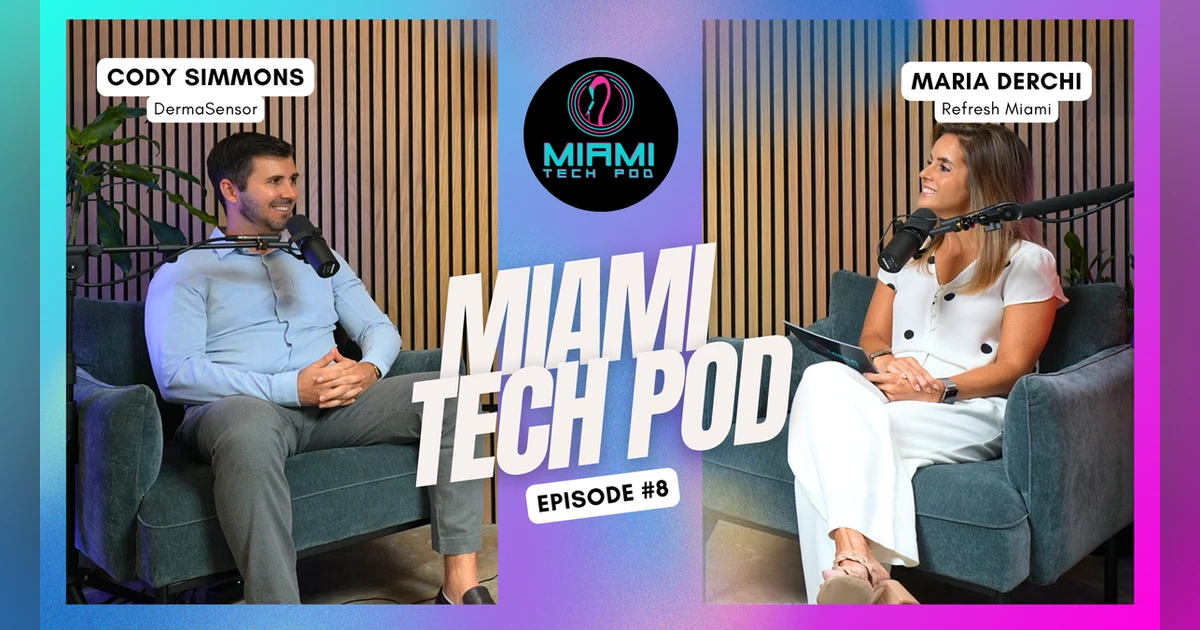
In this episode of the Miami Tech Pod, Maria sits down with Cody Simmons, Co-Founder and CEO of DermaSensor, the company behind America's first FDA-authorized AI-powered skin cancer detection device.
Cody shares the incredible eight-year journey from research project to commercialization — including miniaturizing a 30-pound laboratory machine into a handheld device, navigating the tough FDA approval processes, raising venture capital, and building one of Miami's most promising medical technology companies.
They also discuss:
- How DermaSensor works (and why it isn't just taking photos)
- Why primary care doctors miss up to half of melanomas
- The realities of building a healthcare startup versus software
- The future of AI in preventative healthcare
- Miami's evolution into a serious healthcare and technology hub
00:08 - Welcome And Guest Introduction
00:42 - The Research Origins Of DermaCensor
05:28 - From 30-Pound Prototype To Handheld
08:06 - Live Demo And How Scanning Works
14:30 - Reading Scores And Clinical Next Steps
20:18 - Training And Marketing For Primary Care
25:07 - Triaging Dermatology Waitlists With Data
27:57 - Why Spectroscopy Beats Photo Apps
32:50 - Direct To Consumer And The Lesion Trap
34:08 - FDA Clearance And The De Novo Path
38:58 - Staying Motivated Through Long Timelines
43:33 - Europe Certification And Quality Audits
46:00 - Building A Health Tech Company In Miami
Welcome And Guest Introduction
Maria
Welcome to the Miami Tech Pod. I'm your host, Maria Dircey, and as always, we're recording from the lovely Lab Miami in Wynwood. Thank you to the lab for always being a gracious host. And on today's podcast, we have Cody Simmons, co-founder and CEO of DermaCensor. DermaCensor is America's first automated skin cancer detection device. Welcome to the pod, Cody.
Cody
Thanks for having me. Excited to speak today.
Maria
I feel like we've been at Refresh, we've been covering DermaCensor. I was looking back since we started the news side of the business, so that was in 2018.
The Research Origins Of DermaCensor
Maria
Would love to kind of get into first the origin story of DermaCensor. Um, because I believe it was started out of my alma mater, Boston University.
Cody
The tech did come out of Boston University, yeah. No, so um, and actually originally the original patents were out of Los Alamos Research Institute. Um, and then the engineer that developed it there became a professor at Boston University, Professor Irving Biggio. And that's kind of how Dr. Maurice Forey, my co-founder and our chairman, initially came across the technology, went to medical school there, has been on the board of trustees for decades, and so connected with this uh world-renowned spectroscopy researcher. And there had been a lot of studies using this uh microwave-sized device for non-invasively diagnosing cancer. Actually, most of the research had been on cancers other than skin cancer, esophageal, colon, uh, and so um Maurice, being a physician by background and speaking with some dermatologists he knew, they kind of had this idea of, okay, can we miniaturize this powerful but large technology into kind of a handheld uh light pen was the initial description to ultimately help frontline providers and eventually even patients at home uh scan and test any suspicious moles for skin cancer. So that was kind of the initial idea and vision. The company was um incorporated in 2009. Um and for the first few years, there wasn't any full-time team members, um, a couple uh kind of part-time consultants uh that put a couple devices in dermatology clinics, gathering some initial data, showing that, okay, on skin cancer, this could also work well. Uh, and when they had that proof of concept data, that's when Maurice, I met him, was introduced to a mutual friend, another health tech uh entrepreneur in the area here in Miami, Christian Seal. We went to college together and he connected me with Maurice because he knew about the work he was doing with dermosensor and knew that I had biopsies, my first one as a teenager. My mom and my aunt both had melanoma. Um, and I'd most of my work ever since undergrad had been in oncology uh with genentech and a couple tech uh health tech startups. So um, yeah, he connected us, and and as Maurice put it, uh I'll never remember the phrase, uh never forget the phrase used that uh we're looking for someone to turn our research project into a company. And so I was the first full-time person and was excited. Uh I was pretty young then, not so much anymore, but I was 27.
Maria
Wow, that's a lot of trust placed in you.
Cody
Yeah, and so I I and you know, for me it was a great opportunity. I I uh did my master's research in bioengineering in Stanford and then was at Genentech for a few years, and then a very similar connected medical device screening and monitoring startup called Digicite. So I'd had very relevant experiences, but was still pretty early in my career. So the idea was, okay, um, you know, kind of Cody can be the river and we'll be the banks, you know, to help with kind of guidance and uh network connections, et cetera. Um and yeah, I think, you know, worked out really well working with Maurice and a couple of the other folks that were very involved. Uh the kind of joke term is uh the Mako Mafia, you know, is a spin-on PayPal Mafia. Uh Maurice, David Matlin, Chris Dewey, Ron Abowitz. So Maurice and Rony uh started and ran uh Mako Surgical Together, which was really one of South Florida's first big medical device successes, um, sold for 1.6 billion. So went public, I think in 20, no, I think went public in 2011 and then sold to Stryker for 1.6 billion in 2013. And so the people involved with that, some of the employees and investors went on to start and run various other companies.
Maria
Yeah, and a lot of Miami-based companies, right? Neosis.
Cody
Yeah, Neosis. I know a long while. I'm getting lunch with him in a couple weeks, actually. He's here in Winwood. Uh Neosis, I think they've raised a couple hundred million of commercialized robotic system for dental surgery. So he was an early engineer um at Inside Tech, sorry, at uh Mako and his dad, uh, I believe is a dentist. Kind of that's what got him in the area. The same group, Maurice and others, started uh OrthoCensor, they started Dermo Center, they even named them a similar thing. Uh and it sits on have been early investors and on the board of, I mean, dozens of other companies, uh, several of which are also in in South Florida. And Maurice now runs a company, Inside Tech, which does non-invasive, or sorry, not non-invasive, incisionless brain surgery. Wow. Super cool. Yeah, using high-intensity focus ultrasound to ablate brain tissue. So like a central tremor, uh, brain tumors, uh, they can do brain surgery without cutting into the skull.
Maria
Incredible.
From 30-Pound Prototype To Handheld
Maria
Uh so it originally started, I think I've heard you describe it as a 30-pound microwave-looking device.
Cody
That's right. I didn't bring that with me today. Yeah. It needs to be uh Yeah, I actually like hurt my back once, lugging it around early on because I, you know, in the early days, there were three team members. You know, I brought on our COO eight months after I joined, and then uh director is now uh VP of Clinical Affairs um a few months after that. And yeah, we're like lugging around this huge device in our in the back of our car and kind of carrying it. I think I tried rolling it when I could, but a few times had to carry it. Yeah, it's at least 30 pounds and the size of our microwave, and that's what the spectroscopy system started as. So we gather more data uh kind of to train the algorithm better for diagnosing skin cancer in parallel to working on miniaturizing the device.
Maria
So, yeah, so for folks who are looking who are watching this via YouTube or one of the other video platforms, you can now see how small the device is. It's on the table right here. What was the hardest part about miniaturizing the device?
Cody
Oh man. Um I think probably uh you know, getting the the spectrometer and also the light source, kind of finding high quality but low cost and compact uh uh form factors and kind of finding good sources, tools, testing them. We started off with another light configuration, uh using LEDs and the signal to noise just wasn't there. Um and it would have limited the wavelengths. Our algorithm now is using 47 different wavelengths of light. Human vision we see in three wavelengths, right? Um the LEDs would have been limited to like eight to ten. So there's a lot of uh experimentation really in the first year and a half with kind of what miniaturized components can we use, what are most effective and why, and you know, form factor, how we do this. Um so that probably took in total, it was about a three-year process. First year and a half to two years, we're kind of figuring out what are the core components technically to use, what's going to be most robust. It ended up being like a year to actually do all the design for manufacturing to make it a robust system that can actually be manufactured at scale.
Maria
So, yeah, so to make this more concrete for folks who aren't familiar, I would let's I think we'd love to see the product and you know live and it's you have a do you have a mole?
Cody
I always do the demo mole. I joke I was born for this job. I've got a good demo mole right over the side.
Maria
Well, maybe I was too, because I have one right here. I would love to uh let's test it out.
Cody
Great.
Maria
And then you can kind of explain what's going on in the process. Um maybe we'll yeah, we'll have to be closer to action.
Live Demo And How Scanning Works
Cody
Like I'm the doctor and and you're the patient. And yeah, just to share with everyone, really our focus for this automated skin cancer diagnostic tool, right, has been um really empowering frontline providers. So when you think of your family doctor, internal medicine, uh, obigine, you know, any healthcare professional that you may ask, or they may bring up like, oh, what about what do you think about this suspicious moles? Should I go see a dermatologist? That's what we're really focused on. Because there's about 100 million Americans at risk for skin cancer, but one study showed only 8% receive the recommended annual skin exam.
Maria
Wow.
Cody
So that's about 90 million patients that are not getting the recommended annual skin exam. Um, and wait times for dermatology are already very long. So just from a health system infrastructure or dermatology care capacity standpoint, there's no way that dermatologists can actually take care of the patient population as they themselves recommend should be done. Um and so that's really the kind of vision for decades. We didn't come up with this idea was oh, if only the hundreds of thousands of non-dermatologist providers could more effectively check for skin cancer, right? Because especially melanoma can be very subtle. Uh studies show PCPs, primary care providers, miss up to half of melanoma, so choose not to refer a biopsy it. But also for the ones doing biopsies, they typically biopsy around 20 to 30 suspicious moles to diagnose one melanoma. So only three to five percent of the referrals or biopsies are actually melanoma.
Maria
Wow.
Cody
So that's kind of the real opportunity is helping detect more uh skin cancer, but also avoiding unnecessary referrals and biopsies.
Maria
Yeah. Okay. Yeah. That's so it's not competing with a dermatologist, it's making sure that, you know, PCPs catch it, are, you know, are you?
Cody
Kind of upskill the the but we we like saying sometimes we're we're trying to put the eyes of the dermatologist in the hands of non-dermatologists, um, which dermatologists are quite receptive to because they're the first ones to say, yeah, it'd really be great if the primary care providers in our community uh were more active with checking for skin cancer, we're better at assessing it so they could send us high-risk patients and and moles that actually need to be in our practice.
Maria
Yeah.
Cody
Right. So they're uh some of the biggest proponents and supporters of our work.
Maria
Okay. All right, let's let's check it out. Okay, so right now we are kind of just priming it. Cody is playing the role of a doctor. He is starting by calibrating the device. Okay, success.
Cody
And then uh device is calibrated, it's ready to go. We're gonna go ahead here and take five different uh non-invasive tissue samples of the lesion. Each one of these scans is assessing about a millimeter of tissue non-invasively. So I'm picking it up and putting it down in different parts of the mole, the same way a pathologist will look at different parts under a microscope. But instead of sending it off to pathology, now they have to approved out ones processing the data. Okay, great. So that's a low-risk result, a score of two.
Maria
So, yeah, what are the different results that come back?
Cody
Sure. So it's basically a zero to ten scale. Zero is negative, it says monitor, no uh features of cancer detected. Um, and a positive result is investigated further, and it comes with a one to ten scale showing, okay, to what degree uh of cancerous features is this? Almost like a confidence scale, you can think of it. That's actually what the FDA called it in our one-year review process. Um, and our pivotal study, we had 22 study centers, over a thousand patients uh led by Mayo Clinic, and the uh likelihood of cancer ranged from 6% for a score of one to 61% for a score of 10. So with that easy 20, 30 second non-invasive process, now the doctor knows, okay, kind of where in that scale, you know, it's a tenfold difference in cancer likelihood. Uh now they know where the mole falls on that scale. Uh, and if you get a negative monitor result, which happens about a third of the time, uh, for suspicious moles, um, they depend on which published study, we have not in published studies, uh, the likelihood of being benign is 97 to 100%. So that's kind of if you see monitor, like, okay, very, very low risk, you know, on par with dermatologist or even dermatopathologist saying it's low risk, you know, like this isn't cancerous. Uh, but if you get to investigate further, one to ten scale, now you kind of know, okay, there's some features and here's kind of the likelihood of it actually being cancerous. And then the doctor can decide what to do.
Maria
So usually on the scale, is it if it's like a four and above the doctor says you should go or Yeah.
Cody
So, you know, that uh we make sure that we're clear to our customers or partners that we're a medical device company, we don't practice medicine. We don't tell you how to take care of your patients based on the device result, but there are kind of management guidelines that different providers and health systems have implemented. Um typically, it's actually was a good guess, yeah. So four and above. Um, so typically I people think about is low, medium, high risk. So low risk one to three, medium risk four to seven, high risk eight to ten. And so for high risk lesions, our studies and what we see in real world care, those are almost always referred uh and sometimes even just biopsied by the doctors because they're you know a 40% plus chance of being cancer. So you definitely want to further assess those. Um medium risk are also typically referred. Uh sometimes there, you know, there's certain lesions are called actinic keratoses that have a lot of cellular damage and are kind of known to give off risk scores and they can turn into squamous cell carcinomas a fair amount. So those are ones sometimes like, okay, instead of referring to biopsy, maybe let's do cryo. So we'll freeze it, and then maybe if it comes back, then we'll we'll biopsy and cut it out then. Um so there's, you know, sometimes it depends on what kind of lesion does the doctor does it look like and the device results. Um and then the lower risk scores are the ones where it's more the clinician's interpretation, right? If they're worried it's melanoma, even if you get a low result, like a one, two, or three, okay, a low chance it's melanoma, that's still scary.
Maria
Yeah.
Cody
Right. But if it's a low chance of being basal cell or squamous cell carcinoma,
Reading Scores And Clinical Next Steps
Cody
you know, not necessarily as concerning.
Maria
Aaron Powell So do PCPs go through any training around dermatology? And I think that's a good idea. They do.
Cody
And well, it's funny, this was actually uh uh ended up having a lot of little um I want to say arguments, uh spirited discussions with the FDA over the course of the one-year process and in the last couple weeks and finalizing what's called labeling, right? Like the formal regulatory documentation that goes with the device. They they actually ended up using the phrase, like if you go on, you know, FDA.gov and find derma sensor, um, that it's for use by physicians who are not trained in, I think trained in managing, sorry, who are physicians who are not trained in evaluating and diagnosing skin cancer. And we took issue with that wording because we're like, well, they are trained, they're not specialized, they're not expertly trained, but they do get two days of dermatology training and a couple hours of assessing suspicious skin lesions. It is within their scope of practice to evaluate and manage suspicious lesions. So like saying they're not trained is technically not right. But are they meaningfully trained? Do they have any level of meaningful specialization or expertise? The large majority do not.
Maria
Okay.
Cody
So we ended up kind of the labeling being for physicians who are not dermatologists, right? Which is a much higher bar than just like do they have a little bit of training or not.
Maria
And maybe this is already happening, or do you foresee doctors using the fact that they have this tool to set them apart as to like why they choose them?
Cody
Yeah. So our our marketing group helps uh primary care providers with, you know, here's digital assets and pop-up banners for your waiting room and uh little handouts for patient brochures, uh, because never before in American healthcare have you been able to ask your doctor about a suspicious mole and they test it for skin cancer. It's just never been possible, right? The the patient or the doctor notices something, they they eyeball it, they use their subjective visual assessment and just kind of make their best determination or best guess. But by definition, their evaluation is is like we just talked about, not specialized. They do not have expert level dermatology training. And so I think it really reassures patients and the doctors. We see that doctors' own self-rated confidence and their own rated competency in their effectiveness at evaluating and diagnosing skin lesions goes way up when they're using the device.
Maria
I even see it as like a just second set of eyes, like Yeah.
Cody
We like saying that, like an AI co-pilot or second opinion tool.
Maria
Yeah, because I I even foresee myself, like, even though I try to be good about going to the dermatologist, like if I schedule my PCP six months between meet meet the dermatologist, then like I'll have like every six months, somebody is looking can keep an eye on things and check it just in case.
Cody
No, no, you're exactly right. And that's what yeah, we we see a lot of the our customers and honestly, even just like friends and family and customers will say, Yeah, like patients. We get new patients coming in saying, Oh, like my cousin told me that the mole they had on their arm that you took care of it so well because you had some new AI, you know, skin cancer scanning tool. So I came in because you know, my girlfriend noticed I had some mole on my back, right? Like we hear a lot of those stories, and actually um we're adding on. We uh recently raised a uh 15 million Series B.
Maria
Congrats.
Cody
Yeah, thank you. And uh there's a couple couple stages to it, and so we decided to open, especially marketing's really excited, um, a crowdfunding campaign on a WeFunder because we do see so much kind of uh uh bottom-up support and excitement about the device. And we're like, hey, like instead of just you know, wealthy accredited investors that I happen to get connected to some somehow, what if we have a thousand, two thousand uh micro investors that are now talking to their primary care doctor, talking to their dermatologist, saying, hey, you know, I'm actually an investor in this company that has this really cool device, blah, blah, blah. You know, so we think it's a great way to kind of get a lot more awareness and support out there because over 80% of our sales have been generated from marketing.
Maria
Oh, okay.
Cody
So it's really powered our uh sales to date. And so we were kind of thinking through, okay, how can we leverage like the high profile of the device and the disease and how terrible it is? Um, so we're excited about that. Uh, and we also have a couple big new channel partners, which we're announcing soon that have hundreds of sales reps. So that's kind of our next phase of growth is instead of just our own internal couple salespeople uh kind of following up on some of their, you know, generating their own leads, but mostly following up on leads that marketing generates. Now we're working with companies that already have hundreds of sales representatives that are in touch already with clinics and with health systems. And so can start bringing this up. And it's a pretty easy sales pitch, right? Like, oh, there's if you heard of this automated skin cancer scanner called Derma Center, you know, it's Time Magazine best invention of the year, we're on that list at the end of 2024. Yeah, we um more recently, uh I I kind of laugh, but because we don't belong there evaluation-wise, but uh Inc. magazine, we're best in business at the end of the year in the innovation category within a few rows from anthropic and NVIDIA. You know, and I told anyone like, listen, the yeah, valuation, sure, there's a few more zeros uh with their companies, but in terms of cool tech, like the section is about innovative technology. Like, I think we, you know, we held our own, we belong there. Yeah.
Maria
So I I also my mind starts going to you you mentioned that dermatologist wait lists typically are so long and yeah, it can be several months.
Cody
I think that's a good thing. One of our board members, my mom, I've had to like work on my dermatologist network because they were given, oh yeah, nine months the dermatologist can sue, 12 months they can sue you.
Training And Marketing For Primary Care
Cody
It's crazy.
Maria
But I assume if this dermatologist is being like, hey, this PCP used derma sensor, they got a result of seven, can you push this person to the top of the list? Hopefully that would help.
Cody
So it's so funny you touched on that because I think we had like thought of that as a potential value proposition, but didn't think it necessarily be so impactful. That's actually one of our biggest selling points for health systems. Is they're like, okay, we get it kind of upscaling frontline providers. But that's really interesting now for the first time as a health system, we could objectively systematically prioritize high-risk dermatology referrals. Because there's never been a way to do that before. I've I've spoken with many dermatologists, like, yeah, we tried to implement like an urgent dermatology referral checkbox or kind of process, and it was such a mess because like PCP, some would always check it, some would never check it, some would try to check it, but like half the time they'd be on lesions that weren't actually concerning. Um, so yeah, there's a there's a lot of excitement with that, especially because health systems often experience what's called patient leakage, right? Where their primary care will refer to their dermatology colleagues, but because the wait time is six months, eight months, the patient just never goes to dermatologist, or they realize, oh, well, there's private practices that I can go in often and seen at MP or PA, you know, within a month, I'll just do that. So now health systems can kind of uh uh prioritize or better triage those referrals. And about depending on which study you read, uh about a third to half of referrals from primary care to dermatology are for potential skin cancer. So it's a super common reason patients are referred to dermatology.
Maria
And can you explain what's going on? Because it's not taking pictures of it. It is
Cody
Yeah, it does throw people off sometimes because they're like, wait, it uses light, but it's not photos. Like, how does that work? Um, so yeah, the challenge with photos, there's actually, I think the first publication was like 35, 40 years ago on, oh, let's apply algorithms to photos of skin lesions. And obviously, you know, algorithms and artificial intelligence have improved a lot since then, but there's not a single like photo-based tool that's been authorized by the FDA that's on the market now for uh skin cancer that provides any kind of like risk result, right? Like high, medium, low, or a scale, or here's potential diagnoses that are suspected. Um and yeah, it's you know, it's interesting. Uh, you know, skin of color, it's well known that skin of color photo-based tools do not perform well on because visually they look different, right? If there's hair on or around the lesion, that's a challenge. And at the end of the day, even if you figure out, okay, standardized lighting and distance and hair and skin of color, even if you can figure all that out, you're just analyzing data that's the surface of the skin that the doctor's already staring at, right? It's like how good can it really be ultimately? Uh so our device, and part of why we invested millions of dollars up front miniaturizing this huge spectroscopy system, is it's actually doing non-invasive tissue samples of the skin at a cellular level. So it's um so the light pulses hundreds of different wavelengths of light into the tissue, measuring what reflects back using you know highly precise scientific instrumentation called uh uh optical spectroscopy. The technical term is elastic scattering spectroscopy. And so the cellular and subcellular level features that pathologists will look at under a microscope. Like if folks think back to their, you know, high school like biology textbook, like a photo of a cell right on your textbook page, or is like, oh, it's you know, here's the nuclei and the mitochondria and chromatin and things like that.
Maria
Skin PTSD.
Cody
Yeah, yeah. Back to high school college, those uh reflect light differently to our eyeball, right? That's how human vision works. You know, if if the nuclei of a cell are larger and more dense, they'll absorb more light. That's how a pathologist under a microscope can tell they're larger, right? They look darker to them and larger, et cetera. Um so those same features are what absorb more or less light when our device pulses a lot of light into the cells.
Maria
So will phones ever get to there, to that point?
Cody
Um we have talked with a couple of the big tech companies about that. One actually brought up like, oh, can we put this in a watch somehow? You like pull the watch off and scan or all that. Uh that's pretty far off. But yeah, no, it'd be very easy to do a little attachment to a phone. Because actually most of what's in the handheld unit um are, you know, just typical like running the the touch screen and display and you know, telling the device to pull slight and analyze things that a smartphone could very easily do. So we do think a little attachment that just plugs into a smartphone, right? And then you'd have a little like handheld pen to
Triaging Dermatology Waitlists With Data
Cody
scan lesions uh would be a great next generation device.
Maria
Yeah, because that leads me to my next question. I feel like the industry as a whole, we're our consumers as a whole are getting much more proactive about their health.
Cody
Sure.
Maria
We have I'm like a I'm the one of the extremes of this where I'm like, I'm opting for function blood work and a full body MRI and all these things that instead of kind of relying on the doctor to kind of prescribe a lot of people are you know taking sounds.
Cody
And that's the popularity of the trackers with the rings and the watches. Yeah.
Maria
Do you foresee ever going direct to consumer and having people be able to test their moles at home?
Cody
Yeah. I mean, you know, it's interesting. The the regulations in terms of clinical evidence aren't nearly the bar is not as high in Europe. For example, there are C marked products available in Europe that just use any smartphone. Um there's been some independent studies, like Memorial Stone Kettering did a study a couple years ago uh evaluating the performance of those on hundreds of lesions they had like diagnosed photos of, and the average sensitivity was in the 30s for melanoma. So that's not good, right? That's like missing two-thirds of melanoma is falsely reassuring patients they're fine. Uh so kind of pretty dangerous. I'm not sure it's sad that like many of those are actually available and being used by patients. Only a couple of them actually went through any regulatory process. Um, so yeah, I know it's definitely of interest for us in the future. It is the easier path uh in Europe than the US, because the main kind of question or concern, which is very justifiable, in my opinion, from regulators is how do you know which lesion to scan?
Maria
Oh, yeah.
Cody
We call it the lesion selection problem, right? Like the mole on your arm, great, that's benign, that's low risk. So you didn't go to a dermatologist, but you have melanoma on your back. Right? But you never went, so it never got checked and never detected.
Maria
So I think that's something that it's giving people like a false sense of security.
Cody
Yeah, kind of false sense of security. Or the other direction is like if there's too many false positives, right, where it says, oh, high risk or concerning too often, now you're worrying people unnecessarily. So I think that's why kind of the FDA is very uh conservative with that. And there's been a couple of these kind of smartphone-based companies that have gotten clearance in Europe that have been trying. One, man, when I joined the company in 2016, like, oh, we expect FDA approval next year. It's 10 years later, still haven't been able to. Yeah.
Maria
Yeah, let's get into the FDA clearance. Okay. For those who are not in this industry, take us through high level what the process is to get. Because you guys achieved clearance 2024, correct?
Cody
Uh we did, January 2024. Um so uh the key kind of first step when interacting with the uh kind of the FDA process is get in alignment with the FDA on what studies you need to do to actually
Why Spectroscopy Beats Photo Apps
Cody
get uh authorization. Authorization is the blanket term. There's three classes of medical devices, uh, class one, two, and three. Um so class three is considered approval, like they did a whole review and approve it as safe and effective. Uh class two is cleared, um, and class one, I think, is listed as the term, but they're all collectively FDA authorized, right? So the first step, if you knowing you have a novel tool or will otherwise need to do clinical studies, is what's called a pre-submission meeting. So prior to your submission, you have a pre-submission meeting to align, and we ended up having like five to align on okay, what studies do we need to do, right? So first there's kind of high-level protocol synopses, study designs. Is this kind of approach generally the right approach? And then we ended up having follow-up meetings on two of the studies, the full, you know, 50-page protocols, all the details. Because, you know, what if you include certain patients they disagree with, or and they're like, yeah, no, we like it, but we didn't like this in this piece, redo the study, try again. And you know, that's like a death sentence for a startup, right? Redo a multi-million dollar two-year study. Like, so you really want to get close alignment with them early on. And then we ended up doing one again near the end because a couple of the key people on the review team changed. So, like, well, maybe they have different opinions, and kind of before we start, let's kind of resync up to make sure. And we're glad we did. We made a couple important changes. So we ultimately ended up submitting six clinical studies. Um it was like about yeah, it was about 10,000 pages in total documentation. Yeah, it was a one-year process. The studies in total probably I don't know, spent 15 million plus on. Yeah, it's really intense, especially a few months period, because there's like you you submit the big packet, they review it at a high level, like, okay, it has all the components, so they accept it for substantive review, and then they actually do a couple months of review, they send it back to you, and they stop the clock. So you have basically in short for class two devices, what we did a de novo pathway, where there's nothing similar to it, you have 180 calendar days to basically address everything they want you to address.
Maria
Okay.
Cody
So it's pretty intense because if you get to the end of that and they still have concerns, they'll say submit again, restart. Oh so it was a really intense. Like I was in Europe, I think it was I've maybe taken in 15 years of working, uh, two, maybe three two-week vacations, like typically, and maybe like 10 one-week vacations. I don't know. And so it's like one of the only two-week vacations I ever did, and they sent us back the packet like two days before. I'm like, all right, I'm not gonna cancel it, but I ended up working like half of it.
Maria
Yeah.
Cody
Um and yeah, so it's you you try to get as much done as you can because you never know how many back and forths it'll take. Um, so yeah, that was the most intense, like a few months, like most weeks or a hundred hour plus weeks. I got shingles during it. Um, but we made it. Yeah. We didn't have to restart the one-year process.
Maria
So good, thank God. Uh so wait, it launched in 2000, well, it started in 2009. How many and then till 2024 clearance?
Cody
But so we didn't have any full-time people until I joined in 2016. So that was kind of when we first started really getting off the ground.
Maria
Okay. So uh 2016.
Cody
So it's eight years.
Maria
How long of that was trying to get FDA?
Cody
Yeah. So the high level is uh the first three years were basically miniaturizing the device and doing more data collection on the big device. Um, then four years of running all the studies. The pivotal study itself took two years, but there's supplemental studies and then a couple studies we realized we had to do before we submitted, um, and then a one-year review process. So basically three years on product development, four years on all the clinical studies, and then a one-year review process. So eight years in total, just to be able to start.
Maria
Yeah.
Cody
And that's like that's I remember the board and Maurice, you know, we had our first board meeting post-proof. We had a little celebration party at uh is it Parissa, Amara? Is that the point?
Maria
Oh, yeah, Amara, yeah. Yeah, Parisa.
Cody
Yeah, so yeah, Amara is great. And we had a board meeting a couple days after. I was like, oh great, you know, we're excited and talk through launch plans. Like, yeah, now we get now we get to start. Now we get to like build an actual business. I'm like, man, it's feels like kind of we hit an important finish line, but you're right, it's kind of like now we can actually just start.
Maria
Yeah. How hard is it to keep like with such a long process, like keep the team motivated? Are there like little milestones you set along the way to Yeah, definitely.
Cody
You know, you've got to celebrate, celebrate the little things, especially startup culture. You know, it can be intense and and you know, aggressive deadlines, limited resources. Um, and so yeah, you know, getting the first patients enrolled in a study, things like that, um, you know, signing these new channel partners in the last few months have been big, you know, you don't know yet how well they're gonna work out, but a lot of
Direct To Consumer And The Lesion Trap
Cody
new products are never able even to get the attention or interest from these big companies, right? So the fact that I won't go into details on them yet, we haven't announced them, but three major industry partners, um, one employs tens of thousands of physicians, uh, one has uh hundreds of sales reps, the other is a huge contract sales force, are all now working with us, right? And just within two years, and one of them, the process alone took two years. So they were interested kind of right out of the gate, and we successfully made it through. The other one was a year and a half, the other one was nearly a year. So, you know, we're exactly two years after launch right now. So having those in place just two years after launch is um uh pretty impressive. It doesn't necessarily feel that way because two years feels like a while. But in our world, just in healthcare, uh things move slowly, especially with a lot of these big industry partners.
Maria
Yeah.
Cody
I I feel like this is a natural fit for like Amazon's like one medical or Yeah, that's that's one of uh many of the top health systems we've been speaking with. Uh and then yeah, you can get their clinical leadership, but then you have to get cybersecurity and IT and go through legal and kind of the even when you when you get the clinical leadership saying yes, we want to do this financially, every you know, we want to move forward. It's typically six to nine months after that till you actually have like you're through
FDA Clearance And The De Novo Path
Cody
all their compliance and and IT processes and actually have a completed contract. So it can take you know three to twelve months to kind of get the clinical folks involved and on board and excited and saying, yes, let's move forward, and then it's another six plus months. Oh goodness. Yeah.
Maria
So I know you just uh got approved for commercialization in Europe or as a major certificate. So congrats. Thank you.
Cody
Thank you.
Maria
How did the process compare to FDA approval here?
Cody
Yeah, it was um both were very rigorous, but in very different ways. It was interesting. So FDA, we had all the, you know, safety testing, drop testing, uh, longevity testing, etc., with the uh laboratories that we, you know, oversee and are certified to do various hardware and software testing. And so they didn't, you know, they they kind of went through all those and made sure, okay, all the forms and everything was done, but there wasn't like formal audits of manufacturing. They didn't come on site to our office and have people comb through quality records for days, right? Uh, but they're very, very rigorous on the clinical front, right? Required us to do, we ended up doing two new clinical studies during that one-year process. Wow, it was very um uh detailed in that way. Whereas Europe generally, they're very focused on safety of drugs and devices, but leave it more to the medical community to figure out is this actually going to benefit them and patients, right? So they were very rigorous. They went uh to Vietnam where we manufacture for days doing on-site manufacturing audits. They they did those things. They came to our office in Miami for days doing on-site inspections to make sure your quality systems and controls and manufacturing processes are all robust. Because I think from from their view, Europe, it's like, okay, doctors aren't device and drug manufacturers. So we need to make sure, yeah, we need to make sure these companies are being very rigorous and high quality with that. But in terms of how does it help them and patients medically and stuff like that, you know, sure there's different levels, but they're not as intent on that. Whereas with FDA, it's kind of the opposite, right? Like, okay, yes, we need certain things in place, but we'll more for class two devices kind of assume the company has that taken care of and they really drill in on the clinical evidence.
Maria
So does the fact that you had FDA in the US lead to like an expedited process there or not not to it completely?
Cody
What made the clinical because the FDA is way more rigorous and what we had was ultimately sufficient for the FDA, it made the clinical review really easy for Europe. They had like I mean, literally just a couple questions on the couple hundred page clinical summary we submitted, whereas the FDA basically had like eight months of questions. Right?
Maria
Like so So hardware, notoriously hard. Healthcare, particularly FDA approved require approval requirements hard. How do you not have a full head of gray hair?
Cody
Well, yeah, when I joined, I had zero gray hair, so I definitely have a a smattering of it now. But um, yeah, no, it's funny, that's what people like hardware is hard, healthcare is hard, and dealing with the FDA and going through that's hard, and we're doing all three. So um, I mean, honestly, I think some devices and diagnostic tests and drugs, a lot of it's just about um uh sustaining and existing as a business, right? Like if you're able to uh keep the lights on and just keep the team moving forward, you're ultimately gonna be at least moderately successful if you have good technology and clinical evidence as a foundation, right? Because it just naturally takes so long to get adoption in healthcare and kind of get through a lot of these long processes with with industry partners, with health systems, that a lot of the key challenge is just keeping that momentum, keeping the lights on for the years it takes to ultimately be successful. Um so you know, that's ultimately at the end of the day, a lot of my job as CEO, right?
Maria
Yeah.
Cody
From a financing and the team motivated and you know, our board of directors excited, etc.
Maria
So switching gears a bit, you've been building in Miami since 2016.
Cody
Yep.
Maria
How I mean you've seen firsthand how the city has changed. What has any thoughts? What has surprised you the most over the last 10 years of building here?
Cody
Yeah, I mean uh the metaphor I like describing is uh because I I caught some some uh flack from friends when I moved here, you know, the tech community in San Francisco. They're like, you're moving from San Francisco after being here in the Bay for six years to Miami to start a tech company. Like people do the opposite. Like, what are you doing? Like you're going to kind of a technical.
Maria
You want to make things harder?
Cody
Yeah, you're
Staying Motivated Through Long Timelines
Cody
going to tech backwater. Like, what are you thinking? And you know, for me, it's almost like an arbitrage play. I was like, okay, there's there's tons of talented, uh, you know, smart, um entrepreneurial sorts in the Bay Area, but there's only so many cool technologies, uh, you know, medical and and drug technologies in that area coming out of universities and and uh elsewhere. But uh in Florida, there's not as many people with some of the you know tech work experiences and like working at Genentech, the big drug company I worked at. And so the opportunity to work with someone like Maurice in that group at 27 was really exciting and a big opportunity. And I'm from Florida. My parents both grew up, they went to Miami Beach High.
Maria
Oh my god.
Cody
Uh yeah, and then they went to the University of Florida and never left Gainesville. So I was actually born and raised in Gainesville, uh, but have a lot of extended family down here and um had visit uh visited Miami a lot, obviously growing up. So for me it was a bit of a homecoming anyway. Um and then uh COVID hit, and then everyone's like, oh, you're so smart, you're ahead of your time going to Miami. Yeah, you're ahead of your time going to Miami. So um, yeah, no, it worked out, and and that was something the first couple years I was here. I'm like, I'm like, everyone keeps saying, oh, the the emerging tech ecosystem. I'm like, when is it gonna emerge? Right? It just like keeps emerging, and I think now we really have. Like, I think COVID and kind of the influx of um entrepreneurial talent and uh uh also a lot more investors than kind of the finance community. I think we kind of turned that corner. Um, and you know, people talked a lot about well, the engineering talent we didn't necessarily have great here. And A, I think it improved a lot, right? Especially with the lab and other uh groups, you know, doing coding boot camps and a lot of that stuff. But now with all the Gen AI tools, I don't think that's near as much of a barrier as it used to be. Um so I think that's really helped make Miami even more of a you know uh uh robust tel tech ecosystem.
Maria
Yeah. Fair, I agree. Okay, lightning round. To close it out. Um some of these are might be tougher than others. Um worst startup advice you've ever received.
Cody
In in my world, uh move fast and break things.
Maria
Yeah.
Cody
Sorry, Zuckerberg, right? Was that was that his or Josh?
Maria
Oh, I don't know.
Cody
Oh I don't know.
Maria
I feel like in Facebook they used to have it on a photo. Yeah, exactly.
Cody
I don't know if he came up with it. Yeah, but uh and that came to mind at first because of the Theranos saga.
Maria
Oh my god.
Cody
Right? Like the whole move fast break things is fine if you're not giving diagnoses or or treating people and potentially killing people, right? Like the move fast break thing, sure, it works in software, or it even works when you're in kind of the development stage where like oh like like different uh uh configurations of our device, like, oh, like what should the aesthetics be or the ergonomics, or um, you know, but but when you actually go live with taking providing clinical care to patients, you can't move fast and break things in this world.
Maria
Yeah.
Cody
Um so I think you you try to think of some of that kind of ethos generally with when we think about okay, kind of trying to find product market fit and stuff like that, but when it comes to the actual products and the general uh philosophy and culture of a company, you just can't do that in our world.
Maria
Can't blink it apply it to everything.
Cody
Yeah, like well, let's just try it and go live and see what doctors and patients think. It's like, but if it doesn't work and you don't have studies and like I don't want to go to jail. So no offense, Elizabeth Holmes, but you know.
Maria
Most underrated founder habit.
Cody
Ooh, most underrated founder habit. I mean, on I just don't see how looking back at my own personal journey and and knowing many other CEOs and entrepreneurs, how not working on like nights and weekends that they m me and others would be able to achieve what they achieve, right? I think there's a lot of say, oh well, work-life balance and you know, work productivity declines, people, you know, study show after eight hours. It's like I mean, maybe generally in the population that's true, and you know, it's most people aren't maybe as engaged in their jobs, for example, but like especially in certain periods like the FDA review period, if you can't really buckle down and and uh it's often not healthy to do so necessarily from not just a health standpoint, but I mean also like family relationships. But I think there's
Europe Certification And Quality Audits
Cody
certain periods, at least as a first-time founder, we've just got to be able to prioritize uh your startup and work over everything else. And I think um sometimes people kind of dance around that or say, Oh, well, you shouldn't really need to. And I think if as a second, third time entrepreneur, maybe not, right? Because you're able to raise monies, you're in higher good talented, you're and maybe not as much falls on your shoulders at the end of the day. Um but yeah, I think that's something that for better or worse ended up really being critical for me.
Maria
Yeah. One company outside of healthcare that you admire.
Cody
I've got to say Apple. Yeah. I mean just the the elegant legal kind of monopoly that they've developed with the ecosystem of products and you know everyone loves loves the products, the culture of the company and just the you know striving for perfection. And um I've known a few people that have worked there. Kind of hard hardworking but highly rewarding culture, so a lot of things to admire there. It's cliche, I know, but no no they they earned it. They earned it.
Maria
What's something that people assume about the healthcare industry that isn't true.
Cody
The one I get most incensed about especially having worked for the largest oncology company for four years is that there is a cure for cancer and somehow like the industry's hiding it. Oh yeah I I've gotten that several times while I was working for Genentech from Fran you know it's almost it's like a conspiracy theory thing in some circles apparently and I'm like okay A, my background's in biomedical engineering uh there's no such thing as a cure for cancer. Like there's dozens of different types of cancer and like hundreds or thousands of subtypes. Like it doesn't even make sense. Second of all, it's super insulting to tens of thousands of researchers not just at big drug companies I get how the theory like oh well everyone's on the payroll and they're in everyone's in on the conspiracy. But what about all the academics? What about all the nonprofits that literally dedicate their entire lives to trying to like cure cancer? Like they're all like they Nobel prizes they like infamy for for eternity but they're like giving that up for some reason. Like it it literally just makes no sense. Yeah.
Maria
Okay, last one how can the community help you? It sounds like request this device from your PCP.
Cody
Talk to your doctors about dermosensor yeah we're actually yeah we're doing a
Building A Health Tech Company In Miami
Cody
big push on Florida and also Texas right now. So in that way and yeah with the the WiiFunder kind of community round we're doing it people want to invest I think the minimum is even $250. So you know um every bit helps dollar wise but honestly it's also just you know if you're you're part of our journey and our mission you're that much more likely to you know talk to friends about it, talk to your doctor about it and help in that way.
Maria
And then if any doctors are listening they can kind of go on our website and reach out.
Cody
We want to the call to action first and foremost as you go through the website will be talk to sales rep, you know get a live demo. So yeah that's the best way to reach out.
Maria
Okay. And any hiring for any specific roles?
Cody
Uh we've got a couple roles open now. Yeah product quality engineer oh we're just about to fill our West Coast sales position so that's already done. Oh and we'll be posting a channel partner East Coast role to help coordinate with these new big channel partners and there are hundreds of sales reps and kind of be the quarterback on a lot of the new sales leads and deals that they bring in.
Maria
And did I see an internship role?
Cody
Yeah I think we had a couple posted I know we filled one recently I think it might have been a clinical one. Oh okay um but yeah. All right keep an eye on it and congrats on the fundraise and the thank you yeah it's tough out there but uh but yeah you we we got it done and uh we're keeping on fighting the good fight.
Maria
Amazing thanks for coming on.
Cody
Thanks Maria