How VeryAI Raised $10M to Solve the Internet's Identity Crisis
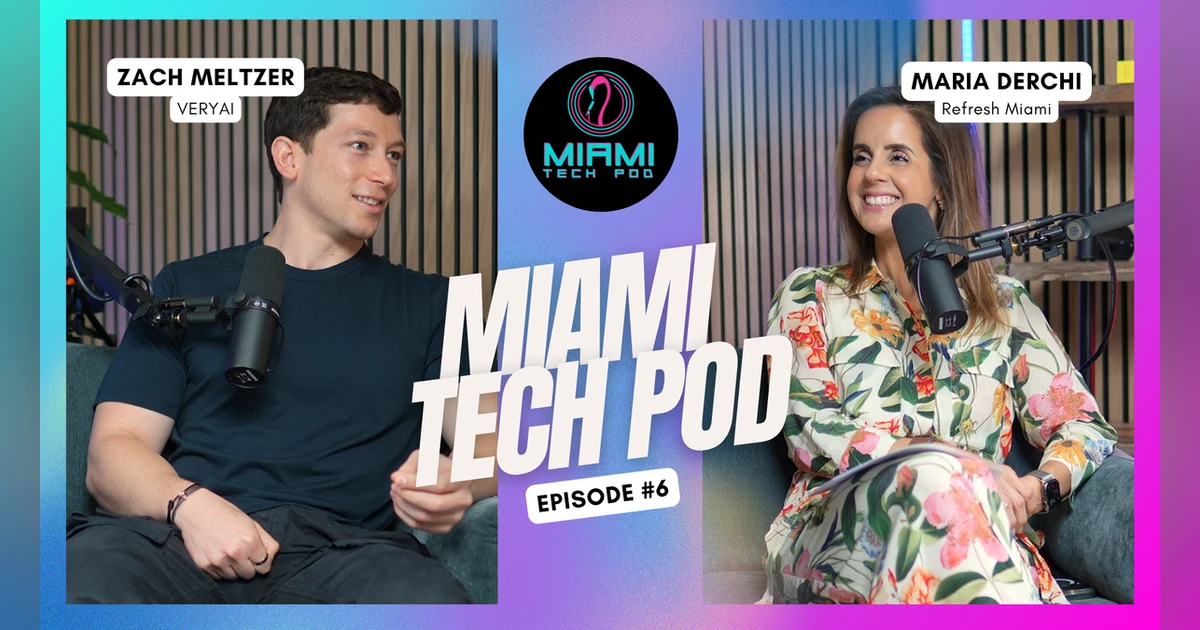
As AI-generated content floods the internet, one question is becoming increasingly important: How do we know what's real? In this episode of Miami Tech Pod, I sit down with Zach Meltzer, Founder & CEO of VeryAI, a Miami-based startup building technology that helps prove you're a real human online using nothing more than a scan of your palm. Zach shares how his experience scaling Galxe to more than 32 million users exposed a growing problem with bots, fake accounts, and digital identity—an...

 Spotify
 Apple Podcasts
 YouTube
 RSS Feed
 As AI-generated content floods the internet, one question is becoming increasingly important:
How do we know what's real?
In this episode of Miami Tech Pod, I sit down with Zach Meltzer, Founder & CEO of VeryAI, a Miami-based startup building technology that helps prove you're a real human online using nothing more than a scan of your palm.
Zach shares how his experience scaling Galxe to more than 32 million users exposed a growing problem with bots, fake accounts, and digital identity—and why he believes the internet needs a new layer of trust. We discuss biometrics, AI-generated content, agent verification, startup fundraising, and what it takes to build a deep-tech company from Miami.
We also dive into:
- Why palm biometrics may be more secure than facial recognition
- The future of "Know Your Agent" (KYA)
- How AI is changing trust online
- Raising a $10M seed round led by Polychain Capital
- Why Zach chose to build VeryAI in Miami
- Lessons learned from scaling Galxe and founding a startup
If you've ever wondered what the internet looks like when AI can create convincing humans, voices, and identities at scale, this conversation is for you.
00:08 - Welcome And Who Zach Is
00:50 - From Galaxy To The Identity Gap
02:47 - Why Mobile Biometrics Beat Hardware
04:12 - Palm Biometrics Accuracy And Scale
07:21 - Privacy Design And User Trust
10:17 - Deepfakes And The Future Of Identity
11:44 - Know Your Agent With AG9
14:04 - Fintech And Social Use Cases
16:07 - Founder Life And Moving Fast
17:16 - Raising Capital Without Losing Time
19:03 - Building In Miami With Leverage
21:06 - Hiring Growth Design And Sales
22:01 - Lessons From Galaxy And Iteration
25:07 - Advice For Students Choosing A Path
26:31 - Miami Talent Density And Office Culture
29:44 - How The Community Can Help
Welcome And Who Zach Is
Maria
Thank you for tuning in. I'm your host, Maria Derchi, and we are recording today from The Lab, Miami. Big shout out to the lab for hosting us. Today on the podcast, we have Zach Meltzer, founder and CEO of Very AI. Very AI is on a mission to make the internet more human, all in the palm of your hand, which I'm excited to dive into today. The company recently raised a $10 million C round led by Polychain Capital. And prior to VeryAI, Zach was head of growth at Galaxy, where he helped scale the platform to 34 million users and 6,000 partners, over 6,000 partners. Zach, welcome to the pod.
Zach
Thanks, Maria. Excited to be back at the lab and talk a little bit more about what we're building at Very.
Maria
Incredible.
From Galaxy To The Identity Gap
Maria
So yeah, I would love to start first with kind of your journey to starting Very AI. And what were you doing? I know you were at Galaxy. What made you decide that this was a problem you needed to tackle?
Zach
Yeah, so I joined Galaxy in 2022 when on-chain credentials and digital identity was a big topic within crypto. There was a lot of things going on in the crypto space at that time, but digital identity and this idea of building what's what was called a credential data network is what brought me to the team. We're a small team, about 20 or 30 people, and we started to grow a lot. And over the course of our time there, we grew a lot. We had over 32 million users within the platform. We had thousands of partners. We worked with the biggest companies in the space like Coinbase and Binance and many others. We started to see a lot of problems around verifying whether a user was unique, they had multiple accounts, or they were simply not real at all, meaning a bot. And we tried a lot of different in-house solutions. We had one of the first, what was called an on-chain KYC. We had our own zero-knowledge protocol, we had a human reputation scoring system. But a lot of these tools fell short in at least one category. Either they were too restrictive for our partners, meaning they saw a drop-off when users were forced to verify, or they weren't restrictive enough. So we s we we started using third-party solutions, but everything really missed the mark. And I had been toying with this idea of building a more secure identity product for two or three years now. And ultimately, a lot of my insights from Galaxy is what led to starting Very.
Maria
Okay. And so we're going to get into kind of what Very AI does, and it has to do with your palm. Well, actually, take us through first, and then I want to know were there other variations of it before you landed on the palm?
Zach
Yeah, so I spent a lot of time post-Galaxy thinking about what is actually going to solve this problem. It wasn't
Why Mobile Biometrics Beat Hardware
Zach
a Galaxy issue, it wasn't a crypto issue, wasn't even a tech issue. This was clearly a universal problem that was only going to get worse. And even since leaving Galaxy almost two years ago now, I think everyone can probably relate to the fact that manipulated or synthetic content online has come into your life in at least some type of way. Whether you're being fooled by what you see on Instagram or Twitter, or your grandparent was tricked by some sort of scam over the phone, this has started to affect people in their daily lives at a much higher rate. So after leaving my last company, I looked for solutions that were A, biometrics, because I did believe biometrics were the best way to solve this, but B was a very mobile-first software-only experience. We had toyed around with some companies that use hardware to scan, to do biometric scans, but you see a big drop-off if the user doesn't have an existing account. Companies like Clear in the airport, really convenient, great solution, but usually you only use it when you're at the airport. So if you have a hardware requirement, it makes it really hard to work with digital or online businesses. So I did believe biometrics were the best way, but I was looking for a very software-only mobile first experience. And when you think about what exists for biometrics that are not reliant on hardware, it's really limited. And through my research, that was when I started learning more about Palm biometrics.
Palm Biometrics Accuracy And Scale
Maria
Okay, speak more about the Palm and like why that is the best fit for this.
Zach
So the Palm is really unique in the sense that it scores high across accuracy, scalability, and privacy. There's a trade-off with every type of biometric that you use. Some are highly accurate, but they require more intense hardware. Some are accurate and don't require intense hardware, but they're less private. So from an accuracy standpoint, at vary, what we've achieved is a one in 10 million FAR. So in biometrics, everything comes down to false acceptance rate and false rejection rate. It's kind of like a false positive or a false negative. False positive would mean I sign into your account when I shouldn't have, and false rejection means I can't sign back into my own account. So no biometric is 100%, but every company aims to get as high as they can. So our baseline minimum false acceptance rate is one in 10 million, which is 10 times higher than what you use with your iPhone every day. So Apple Face ID, their self-reported FAR is one in one million, which means every one in one million, there's a chance that there's a false acceptance. And our one in 10 million is actually our baseline minimum solution. So that's a single scan of one POM. When we introduce both POMs and multiple scans of each, we actually achieve an FAR all the way up to one in 100 trillion, which probably sounds like a fake number. But when you start to increase surface area and the volume of the scans that you do, we see an exponential increase in the accuracy. So the first pillar is accuracy, the second pillar is scalability. So hardware biometrics are really difficult to scale, especially if you're looking to provide a global solution just based off distribution and cost. It's very hard to get an actual hardware device in everyone's home. It's very unlikely that I'll ever have multiple devices sitting on my desk at home just to perform a verification. So by using a phone camera only approach, we're able to scale globally, also at a much more efficient cost to us and to our partners. Lastly, which is most important to me and to a lot of other people as well, is the privacy aspect. Other biometric modalities like your face, your fingerprint, or your iris, you've likely already attached that to your identity. Your face is inherently attached to your identity, people can find that out fairly easily. But even things like your fingerprint or your iris, you've probably shared that information with the government or some third-party agency already that can link that back to you. Even companies like Facebook, you don't commonly think about it, but they have one of the largest facial databases in the world. So your POM is much different in the sense that you haven't linked that to your identity yet. Or at least most people haven't. You haven't been requested that information nearly as much as other biometric options, and you most likely haven't linked that at some point in time. Again, whether it's the government or TSA or CLEAR, most of these companies have not yet monetized POM biometrics, which means with Vary, you can prove that you are a unique and real person without actually saying this is Zach or Maria.
Privacy Design And User Trust
Maria
Now, as people start to do that, does it then become too tied to their identity? And I know specifically you guys turn the POM into an irreversible mathematical equation that can't be Yeah. Can you speak a little to that?
So everything at vary is fully encrypted. So even when we work with our partners that integrate our solution to their platform, they're not receiving information of who this user is. And we don't actually ask people for any information. So you get a unique ID that's encrypted after scanning your POM, and only again, the like you mentioned, the irreversible features are saved. All the raw biometrics are ultimately deleted. So we don't ask you for pictures of your face or any documents that can actually lead back to you. So everything at vary is fully pseudonymous or anonymous as people would say.
Maria
So I know a lot of hesitation around biometrics in general, people feel like surveillance. Is a lot of it just educating them on what you just said about like we're not saving any of this, this is you know unique to you, like you're we're not sharing anything.
Zach
Yeah. Those are typically the two biggest roadblocks that any company building in our are vertical face, and they go hand in hand. One is overall sentiment towards biometrics. Um people have definitely become a lot more sensitive to sharing this information. And that's happened really within the past like five to ten years. I think before that, you know, we didn't have biometric requests on a daily basis. People pretty much forget that facial biometrics even didn't really come into our daily life until 2017. In 2014, Apple acquired Face ID from a couple uh technology entrepreneurs, and in 2017 it was released. Before that, you were really only being asked to scan your face at like higher security checkpoints. Again, whether it was in the airport or maybe you had to do like a full KYC for a financial platform, that was typically when you'd be asked. But you weren't scanning your face on a daily basis. So we saw the introduction of face ID, then other phone providers started using facial biometrics as well. And we also saw the adoption in things like your condo or your apartment. You see the face scanners to enter the building sometimes too. So there's been a rapid growth in the amount of like biometric requests that we see in our personal lives. So we have started to see a fatigue there. So one thing is just overall sentiment towards biometrics and making sure that people know it is private and it's not being stored because some companies do store. They're not lying about it, but they just have a different model than we do. And and the other is is actual education. When you hear fingerprint or iris, most people think of biometrics. When you hear POM, it's not necessarily the same thing. Um most people haven't heard of POM biometrics, they don't know what that is. But again, fingerprint, iris, those words usually associate with some sort of identification. So there is an education aspect that we need to overcome.
Deepfakes And The Future Of Identity
Maria
Now, what do you think people are underestimating about the future of identity online? And what do you think sounds crazy now, but in five years will not sound crazy at all?
Zach
I think people are underestimating the existing tools that we use becoming fairly useless in in the near future. So we've seen like deepfakes and AI generation, especially around image and video, rapidly advance, really within the past like 12 to 18 months. And every 90 days we see a pretty big jump. And we're finding it very difficult, uh other companies as well, to keep up with that from a sense of AI detection. So we see trillions of dollars being poured into AI generation right now, just through funding and venture capital, but not even billions being put into AI detection. So the rate of generation is far outpacing detection, which makes it harder for companies like us and other identification companies to keep up with that. Um, but the ones that are affected the most are facial images right now, because that is the modality that has the most widely available images online. So it's easier to train models to fake a face rather than your palm because there's much less palm data on the internet widely available. So I do think we'll start to see the gap between being able to use facial biometrics grow larger and larger just because of how good AI generation is getting.
Know Your Agent With AG9
Maria
Now I'm glad you brought up AI. Obviously, that's the biggest topic these days. And I've heard you speak a little bit about, you know, current day there's KYC, moving forward it'll be KYA. Can you speak a little to like how you guys are thinking about this?
Zach
Yeah, we we spent a lot of time iterating on KYA and agent verification recently. We're far from the only company talking about this right now. Um, we think about it a little bit differently than others. Most companies think about know your agent from a financial perspective, which will absolutely be necessary. So you can take certain financial credentials or actions from an agent, and you can build sort of like a reputation for this agent through those previous transactions. Um, and then it'll be focused on payments from there. When you want to use your agent to make a payment, you can see the sort of like credit history or finance history of this agent. And a lot of people are thinking about KYA that way, and that'll certainly be a piece of it. We think about it a little bit more top-down, where you're connecting a human aspect to this agent. So we released a product called AG9, which essentially allows you to cryptographically bind your human registration to this agent and also give it a level of accountability so that if you want to use your agent, let's say to trade $500 on Robinhood, Vlad, the CEO of Robinhood, actually yesterday announced that you can now use agents to trade for you on the platform. And today, agents are still very developer focused. So people love talking about them. Most people are not using them yet. But we will move into a future where people are starting to use agents significantly more than they are today. We see more usage, we see more agents, and we will need some level of verification or accountability so that Robinhood knows you actually deployed and owned that agent, and B, it has permission to trade on your behalf. So with our product, AG9, you can prove ownership and you can also prove that you gave permission to this agent to trade X amount. You can also revoke permission to make sure that your agent doesn't hallucinate, as a lot of developers call it, meaning it's performing tasks that you didn't actually allow it to do. Um so we like to call this like a level of accountability.
Maria
And that's already live now.
Zach
That's live today,
Fintech And Social Use Cases
Zach
yes.
Maria
So who are some of your current customers and how do you see that evolving over time?
Zach
Yeah, right now our focus is mostly within fintech and social media. So we work with exchanges, crypto and non-crypto, um, and we're starting to speak to more social media companies as well. Because we don't rely on hardware, there's a very wide range of the type of customer we can work with. We're not really limited to one use case or one vertical. Um, but being a small team and just getting started, those are our main focuses right now. I do believe within the next couple of years, it'll be a very agnostic technology that almost every online business needs some level of. But today, social media and fintech are the most adversely affected. Um you see the platforms that most people use, like Twitter, Reddit, Instagram, all publicly speak about the risks that they're at. Each one has a slightly different approach, but the user experience is probably what is most common among them. So, as a user, if I go to a social media platform and all the accounts are fake and all the uh media is generated, it creates a very poor user experience, and maybe I don't want to come back to the platform. So they've all been pretty public about speaking about adding new solutions, trying out different options. One of the most important things is to respect like the user's privacy in that process. That's why you haven't seen all of them go down like a very intensive you know verification route. Um and and we'll really start to see you know more of these companies adopt some level of of you know human verification pretty soon.
Maria
Okay, so mainly B2B right now.
Zach
Mostly B2B. Okay.
Maria
Do you see yourself going B2C eventually?
Zach
We have some level of B2C. We're about 90% B2B from just the overall transaction count that that we see coming in, meaning registrations and re-verifications. Um we have a native app that you can download in the iOS or the Android store. Um, but most of our significant volume comes from partners directly integrating our solution to theirs.
Founder Life And Moving Fast
Maria
So you started the company about a year ago, correct?
Zach
Just about a year ago, yeah.
Maria
Okay. What is your one year into founder life? What has surprised you most about being a founder?
Zach
Um it's definitely a lot less glamorous than people make it out to be. Um I think you know, the first probably six months, there's there's a lot of iterating and learning, and it's different for each company. We have a deep tech product that required a lot of you know legwork to get live. Um other types of more software-focused companies or trading companies, you can move a little bit quicker in the beginning. So for the first six, seven months, it was just myself and and engineers um building the product. We were pretty much less than five people for a lot of the time. Um and I think you know, one of the biggest things is is, at least for me, is just realizing the biggest aspect is time is against you. So you need to be able to ship at a very high quality, but also at high speed because there's always someone else trying to come out and compete with you, and your funding and your capital doesn't last forever. So it's not just about being successful in terms of the quality that you ship, but also being able to do it at an extremely high pace.
Raising Capital Without Losing Time
Maria
Now, congrats on the $10 million seed round. Can you speak to kind of how that came about, what the fundraising experience was like?
Zach
Yeah, you know, I think it's it's a pretty back and forth process. Um, you know, Polychain was was our lead, so you know, we we knew that that we had their support. Um, and then we also raised from a firm called the Bergruen Institute, which does mostly like science and research based based uh investments. But no, I think most people get caught up in in the investment stage. Uh it's easy to do so. You want to get a lot of people involved, you want to get excited, but it's another situation where speed is actually much more important. So you can drag out your fundraising process six months, some people even do longer to a year. Um, but it's more important to find, you know, really smart investors that believe in your mission. You don't need everyone's support. You only need one or a few people's support. It's kind of like dating in a way, you know, you don't need everyone to like you. Um you just need a couple strong believers that that can also help you and be strategic. So, you know, if if I had to go back and do it again, I would I would say, you know, my my recommendation to others is just find, you know, a couple or even just one really strong believer in in what you're building and and align closely with them. And you know, the rest will will come later.
Maria
And did you already have a relationship with Polychain before?
Zach
I knew them a bit. Um definitely expanded the relationship a lot, you know, through the fundraising process, though.
Maria
So how long would you say the fundraising process took you?
Zach
I mean, it started the day that I I left my my last job. Um, you know, each investor, you know, comes on at a different pace. A lot of people focus on finding their lead investor first. That way you know the the rest of the round can can come together. Um but it took us a few months to finalize everything.
Building In Miami With Leverage
Maria
And so uh I learned that you're born and raised in Miami. We love that. Uh what makes you stay here? What keeps you here?
Zach
Yeah, a lot of people ask me why I don't move to San Francisco, and and I do spend a good amount of time there. Um, you know, A, A, I love being in Miami. I have family here, I have friends here. Um, but more important than that, I think we are at a pretty big point in time for Miami. Uh there's a lot of attention. I think everyone sees the news about other, you know, top founders moving to Miami. And obviously there's some advantages to being in Silicon Valley or the Bay Area, but it's actually a lot easier to stand out here. So every day in San Francisco, you see some sort of seed funding announcement or raise about some new young entrepreneur. We don't have as much of that in Miami just yet. I think it'll continue to change, but I do believe you can use that to your advantage. Um we also live in a in a very global world, so I think you know, moving to the Bay Area has been become somewhat of a cliche. Like there are advantages to it. And, you know, maybe I'll bite my words in the next year and I'll be living there. But um, you know, there's a lot of advantages to being in a smaller market.
Maria
Yeah, I'm glad you mentioned. Well, one thing I kind of wanted to say is, yeah, I feel like every now and then someone I know will, you know, get some crazy job offer in New York or San Francisco, and they'll kind of tell me that they're moving and they'll be a little scared about my reaction. And I'm like, people are allowed to come and go. Like I'm not here to say everybody has to stay here forever. Like hopefully they'll find their way back. But I I think we just we've got to be comfortable. I'm born and raised here, but I left twice. And so I think making people feel like you know, we understand if you need to go, there are other opportunities. Hopefully, you'll eventually find your way back. More people, it's it's just like unrealistic to expect that everyone whoever moves here is gonna stay here forever.
Zach
So for sure.
Maria
So even if you do leave, we we expect you to come back. Uh so I know that you're hiring.
Hiring Growth Design And Sales
Maria
Uh can you want to speak to some of the roles you're looking to hire?
Zach
Yeah, we're we're a pretty lean team today still, which is pretty amazing what we've been able to accomplish with a sub-10-person team. We're looking for a lot of growth roles right now. So we've kind of gotten over the first hump in terms of building. We're definitely still in the zero to one phase. Um, but we've built most of what we have today with myself and then engineering and product resources. So we're definitely expanding on the go-to-market, which is sales and business development, as well as marketing. Um, I think we'll we'll start to see a lot more companies have these, you know, sub 10 person teams and one person departments. But at least today, most of what we're hiring is around marketing and sales, um, as well as design. Because we have a deep tech or futuristic seeming app in a lot of ways, design is pretty important to us as well. So we're all always looking for top tier design. Talent as well.
Lessons From Galaxy And Iteration
Maria
From your time at Galaxy, what is like one lesson that really you kept that has helped you become a better founder?
Zach
Yeah, I I definitely learned a lot from the founders at Galaxy. Charles and Harry were really excellent founders. And you know, I joined Galaxy at an interesting time. It was 2022. I was still a student, actually, full-time at UM. And I was hellbent on joining crypto. Most of my professors thought it was a joke, family as well. Went through a lot of different rounds with interviews in different companies, found Galaxy, felt like a big feat. I think I joined halfway through through my last years at UM, so I was still a student. Was really excited about this idea of credentials and identity that we were building. And then 10 days after I joined, uh, FTX collapsed. So that was like my intro to the full-time professional world after college. I had been working full-time before that. But that was a great time to join a company because we we had a lot of trial and error. Uh things got quiet. We had a big bear market in crypto. Um so we were able to just iterate and build and try things out. Some worked, some took off, and a lot didn't. And I think you know, that was one of the biggest learning lessons for me was being able to try things out, let them fail. Some will do well, some won't, but not stopping just because one idea doesn't work out. Um, you know, we have a pretty niche product at Vary, so we're very focused on one thing. Um but you do need to build new things and try them out and be okay with not everything taking off. So, you know, we've expanded outside of just pure POM biometrics into agent verification, like we talked about before. And it's a it's a never-ending iteration of building and trying things out and seeing what works. And you see that from you know, many, many of the other top companies in in tech. Um, there's pivots, there's changes, there's product launches that don't work out, and you really need to be comfortable with not knowing necessarily what's going to stick and what's going to take off.
Maria
Is that kind of the corporate culture you're building at very eye, like a curiosity and okay with things?
Zach
I definitely wouldn't say corporate culture. Um, I think an early stage startup in many ways is is almost more of like a friend group than a corporate company. Um so you know, I put a high level of trust in everyone on the team. We have really high expectations as well to move quickly. Um, but definitely, you know, and an understanding to you know, stay curious for sure. We have a product that no one else has built. So sometimes you base your product off top competitors that came before you, which typically is actually a pretty good model to go off. If you're building a finance app or a payments app, look at Venmo, look at Cash App, and just do what they did, obviously with your own value add. For us, we don't have that. We don't have anyone to copy necessarily. So we do have to try things out, iterate, see what looks good, see what doesn't. Um but yeah, curiosity would would probably be one of our core pillars.
Advice For Students Choosing A Path
Maria
So for some of the students sitting in the UM classroom right now, debating what they want to do, what would your advice be?
Zach
It's funny. I was actually at UM speaking uh just a couple of weeks ago, and we spoke about this. I think um UM specifically is starting to do a better job of bringing in resources to teach people about um tech and going into the space. Um I would say just ignore what everyone else is telling you. Do what you like, don't worry about the money. Um you have to do something you like, and if you're good at it, the the money will come. If if you're not good at it, then you know you can always go back and try something else. But you're really young, you don't want to be worrying about, oh, am I in the right industry or not? Um really just just find something that that gets you excited. Um that's the only way you're actually gonna be willing to work hard. If you're at a job that you don't like, uh it's very difficult to find the you know the the willpower to just work through it. Um so find something that keeps you up at night and and gets you up early in the morning.
Maria
So don't take the safe bet, lead with your passion.
Zach
Never take the safe bet. That's usually boring. Sometimes you have to. Um but but do something that that really does get you excited. Do something that you're willing to put in 14 hours a day. And some people might think that's a cliche, but that's the only way that that you'll actually end up liking what what you do every day.
Miami Talent Density And Office Culture
Maria
Aaron Powell So back to the Miami topic. You kind of spoke to the the pro of being a like a big fish, small pond. Uh any other major pro and then major con that we need to work on?
Zach
I think you know, for the past, I would say like five years, people have always been saying, oh, there's so many people in tech moving to Miami. Um, you know, it's becoming like a kind of a new hub. And previously I would actually say not really. Um now it's starting to change. I would say it's mostly been like exited founders that you see coming to Miami. Now we start to see that change with leaders from like Google and other top companies coming to Miami. Um so I would say the advantage is like attention. The attention's definitely on Miami. I think from the outside perspective, people want to see if this is real, if it's legit, if people are coming here just to have fun, or there's actually a growing tech culture in Miami. We definitely don't have to like replicate any other city. We can continue to do what we have here. But attention is always going to be an advantage. Whether you're in Miami or not, at a startup, usually you need attention to grow, to get users, to get more funding. If you have an amazing product but you have no attention, it doesn't really matter how good the company is. So attention is helpful. Um, I think Miami will probably always lack the same level of like a working or corporate culture that that other cities do have, just from a sense of like office buildings and um, you know, companies having HQs here. It's it's definitely more limited. Um so you're you do have a more remote sense of work culture here, which I think works against a lot of people and and companies. I'm not a big fan of remote work. I think having everyone in the same room every day is is a huge advantage. So I am curious to see, you know, as more people start to move to Miami, if we have proper headquarters here rather than just you know remote workspaces.
Maria
When you're hiring, how hard is it to find folks that want to be in office versus remote or hybrid?
Zach
I think a lot more people have warmed up to going back into office. Um we kind of go back and forth with this, you know, how strict do we want to be about getting people in the same city? So far, we've had pretty much hubs here in Miami, San Francisco, and New York. So we've you know limited to those three cities. In I would say the first half of this year, we were really strict about it. Only wanted people in those cities. But I would say now, one thing looking back, for for like a small team, sub 10 people, speed becomes more important. So speed and talent density are the most important things. When you have 20, 30, 50, 100 plus people at a company, you kind of have the luxury to take a little bit more time with your hiring process. When you're a really small team, you don't have that luxury. So everyone says hire slow and fire fast, um, which is true. But sometimes you really need the help. You really need a person. So you you want to opt for speed and talent rather than location, if you can. Um and as you grow, you can start to get people into places that you really want
How The Community Can Help
Zach
them.
Maria
Closing question. How can the community be helpful to you?
Zach
I think the community can be helpful going back to what we talked about earlier, just staying curious and building cool things. Miami's had a split reputation, definitely, you know, within this space over the past 10, 15 years. And it's mostly just about what cool things do people see coming out of Miami. I think we see a lot about you know, venture right now and top founders moving here. Less about like, oh, this pro this startup you know grew in Miami. Um, I think the more names that we see that are associated with Miami is gonna help the community more. And in turn, that helps the the builders that that are here.
Maria
So keep building, uh keep making Miami proud for the positions you're hiring for, and then ideal customers if they want to reach out to you.
Zach
Yeah. Um, you know, we're again we're working with all sorts of fintech companies, social media companies pretty soon as well. You can visit our site, very.orgver.org. Um you can reach out to us. Hello at vary.org. Um, and and we're happy to to work with with anyone that that we can help.
Maria
Amazing. Thank you, Zach.
Zach
Thank you, Maria.